
New Zealand’s warmest November on record
| Temperature | Temperatures were well above average (>1.20°C above average) for almost the entire country. Parts of Fiordland and north Westland observed above average temperatures (0.51-1.20°C above average). |
| Rainfall | Rainfall was well above normal (>149% of normal) or above normal (120-149% of normal) for most of Northland, Auckland, Waikato, the Bay of Plenty, Taranaki, southern Marlborough, Fiordland and southwestern Stewart Island. Rainfall was below normal (50-79% of normal) or well below normal (<50% of normal) for most of the remainder of the North Island, as well as Canterbury, eastern and central Otago, and eastern and southern parts of Southland. Elsewhere, near normal rainfall (80-119% of normal) fell in November. |
| Soil Moisture | At the end of November, soil moisture levels were lower than normal along the east of the North Island, from coastal Gisborne to the Wairarapa, as well as eastern parts of Canterbury and northern Otago. Soil moisture levels were higher than normal across western parts of Southland and Otago, Grey District, Buller and Tasman, Taranaki, and most areas north of the Central Plateau. Near normal soil moisture levels were typical for the remainder of the country. |
Overview
November began with a week-long settled spell for most of Aotearoa New Zealand, as high pressure remained slow moving nearby: a notable change after a dramatically unsettled October. High pressure systems frequently lingered to the east of the country through the remainder of the month, bringing more northerly-quarter winds than normal.
La Niña conditions continued through the month of November. Sea surface temperatures (SSTs) surrounding New Zealand were mostly above average, with considerably higher than normal SSTs for the time of year about the northern half of the North Island.
Marine Heatwave (MHW) conditions were present about the North Island and near the coasts of Nelson, Canterbury, and east of Stewart Island.
The nationwide average temperature in November 2025 was 15.9°C. This is 2.2°C above the 1991-2020 November average, making it New Zealand’s warmest November on record.
New Zealand’s previous November record (set in 2022) was 15.5°C, so the 2025 temperature has exceeded that value by a considerable margin.
Notably, the country’s November 2025 mean temperature is higher than the nationwide average December temperature (15.8°C) – in essence summer-like temperatures began one month early this year.
The persistence of northerly-quarter winds during November contributed to the exceptional warmth, as airmasses passing over the country were mostly sourced from interior Australia and the Coral Sea (east of Queensland).
Low pressure systems were able to tap into the warmth and moisture of these Coral Sea airmasses, leading to several periods of heavy rainfall for the upper and western North Island. As a result, rainfall was well above normal (>149% of normal) or above normal (120-149% of normal) for most of Northland, Auckland, Waikato, the Bay of Plenty, and Taranaki.
Rainfall was also above normal or well above normal in southern Marlborough, Fiordland and southwestern Stewart Island. In contrast, it was a dry month for much of the lower and eastern North Island, and many eastern, inland and southern parts of the South Island. Rainfall was below normal (50-79% of normal) or well below normal (<50% of normal) for southeastern Gisborne, Hawke’s Bay, Whanganui, Manawatū, Wairarapa, Wellington, most of Canterbury, eastern and central Otago, and eastern and southern parts of Southland.
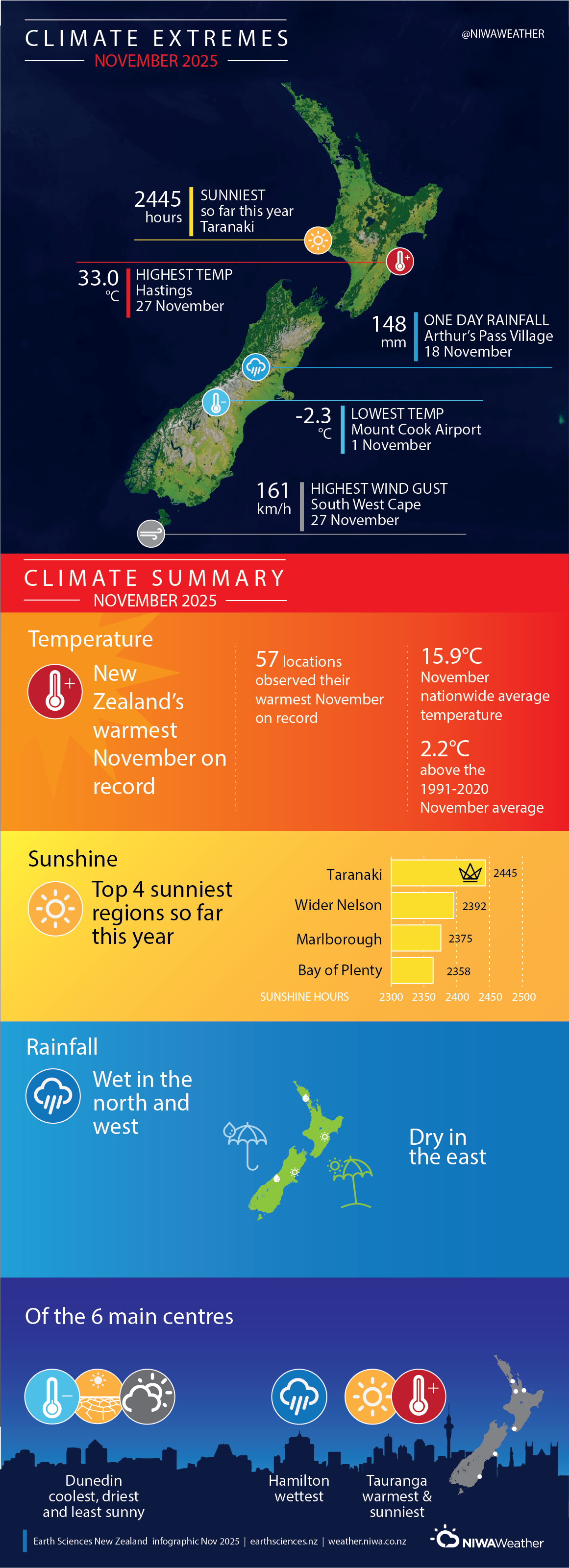
Further Highlights:
- The highest temperature was 33.0°C, observed at Hastings on 27 November.
- The lowest temperature was -2.3°C, observed at Mount Cook Airport on 1 November.
- The highest 1-day rainfall was 148 mm, recorded at Arthur’s Pass Village on 18 November.
- The highest wind gust was 161 km/h, observed at South West Cape on 27 November.
- Of the six main centres in November 2025, Tauranga was the warmest and sunniest, Hamilton was the wettest, and Dunedin was the coolest, driest and least sunny.
- The sunniest four regions in 2025 so far are Taranaki (2445 hours), wider Nelson (2392 hours), Marlborough (2375 hours), and Bay of Plenty (2358 hours).