
Guidance on high frequency water quality monitoring has been released in 2025.
Prepared by Earth Sciences New Zealand (formerly NIWA) researchers in collaboration with regional councils as part of the High Frequency Water Quality (HFWQ) Monitoring Guidance Project, the guidance available here for download will help local authorities, environmental practitioners, community groups, and individuals to plan HFWQ monitoring.
To be involved keep up to date with this project, please subscribe to our newsletter.
To learn more about the new field operations project, please download this flyer.
High frequency water quality field operations guidance [PDF 1.7MB]
Supporting the use of water quality sensors in rivers, lakes and estuaries for continuous monitoring
Please select the reports to download.
| Citation | Download | |
 | McKergow, L., Wood, D., Hudson, N., Arnold, J., Woodward, B., Elley, G., Milne, J., MacDonald, I. Crawford, R. (2025) High frequency water quality monitoring guidance – Project overview and data standards. Envirolink Tool prepared by NIWA. NIWA Client Report 2025317HN. http://www.envirolink.govt.nz | Project overview and data standards [PDF 1.54 MB] |
 | McKergow, L., Hughes A. (2025) High Frequency Water Quality Use Cases and System Design. High Frequency Water Quality Monitoring Guidance. Envirolink Tool prepared by NIWA. NIWA Client Report 2025316HN. http://www.envirolink.govt.nz | User cases and system design [PDF 5.99 MB] |
 | Wood, DRR. (2025). Automated Anomaly Detection. High Frequency Water Quality Monitoring Guidance. An Envirolink Tool prepared by NIWA. NIWA Client Report 2025314HN http://www.envirolink.govt.nz/ | Automated anomaly detection [PDF 1.4MB] |
 | McKergow, L. (2025) Algal fluorescence sensor selection. High Frequency Water Quality Monitoring Guidance. An Envirolink Tool prepared by NIWA. NIWA Client Report 2025313HN http://www.envirolink.govt.nz/ | Algal fluorescence sensor selection [PDF 4.5MB] |
 | McKergow, L. (2025). Dissolved oxygen sensor selection. High Frequency Water Quality Monitoring Guidance. An Envirolink Tool prepared by NIWA. NIWA Client Report 2025310HN http://www.envirolink.govt.nz/assets/ | DO sensor selection [PDF 5.6MB] |
 | McKergow, L. (2025). Electrical conductivity sensor selection. High Frequency Water Quality Monitoring Guidance. An Envirolink Tool prepared by NIWA. NIWA Client Report 2025311HN. http://www.envirolink.govt.nz/. | EC sensor selection [PDF 5MB] |
 | McKergow, L., Vincent, A. (2025). Optical nitrate sensor selection. High Frequency Water Quality Monitoring Guidance. An Envirolink Tool prepared by NIWA. NIWA Client Report 2025308HN http://www.envirolink.govt.nz/ | Nitrate sensor selection [PDF 7.7MB] |
 | McKergow, L., Hughes, A. (2025). High frequency water quality resourcing. High Frequency Water Quality Monitoring Guidance. An Envirolink Tool prepared by NIWA. NIWA Client Report 2025315HN. http://www.envirolink.govt.nz/ | Resourcing [PDF 2.26 MB] |
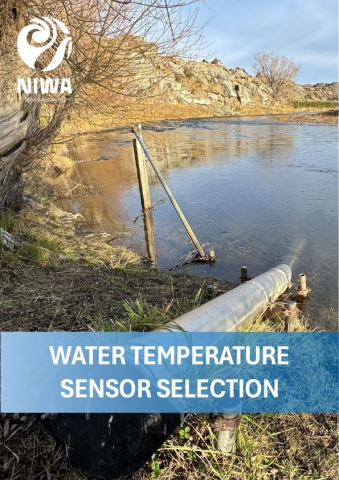 | McKergow, L. (2025). Temperature sensor selection. High Frequency Water Quality Monitoring Guidance. An Envirolink Tool prepared by NIWA. NIWA Client Report 2025309HN. http://www.envirolink.govt.nz/assets/. | Temperature sensor selection [PDF 4.6MB] |
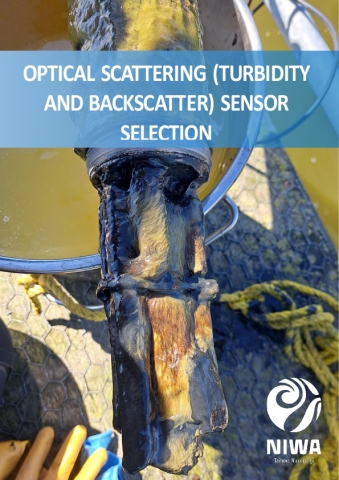 | McKergow, L. (2025). Optical scattering (turbidity and backscatter) sensor selection. High Frequency Water Quality Monitoring Guidance. An Envirolink Tool prepared by NIWA. NIWA Report 2025312HN. http://www.envirolink.govt.nz/. | Turbidity sensor selection [PDF 6MB] |
About this project
The new EnviroLink Tool project (2025-2027) is delivering best practice guidance to support data quality assurance and field operations, bringing together technical knowledge from experienced sensor users. The guidance will sit alongside available NEMS and provides ‘how to’ guides for technical staff to shorten the learning curve for new users and accelerate the collection of high quality HFWQ data at regional and national scales. The project focuses on:
1. Deployment planning –saving time and effort on designing sensor installs and reducing the likelihood of deployment failure.
2. Data quality assurance (QA) – guidance on lab and field operations to support the collection of high quality HFWQ data through sensor placement and data collection.
3. Field operations – detailed technical guidance is required to ensure data collection is cost efficient, including installation, maintenance, and quality assurance checks.
Opportunities for regional council staff
The expertise of regional council staff is needed to improve this guidance.
You can help by: participating in workgroups and workshops, sharing methods and design details in deployment method surveys, sharing your standard operating procedures, and sharing photos of your field operations.
High-frequency vs traditional methods
The commercial availability of water quality sensors provides an opportunity to explore water quality dynamics at time scales of minutes to hours. It is tempting to deploy available sensors to satisfy our natural curiosity about water quality variability. A widely held expectation is that emergent Internet of Things (IoT) technologies will enable HF monitoring of water quality everywhere. However, the reality is that many challenges — biofouling, varying environmental conditions, technical problems, sensor limits and limitations — reduce data quality. These challenges can all be managed with a combination of thorough planning and careful sensor operation and maintenance, but it requires sufficient resourcing.
The guidance covers when HFWQ sensors are appropriate, resourcing requirements, sensor selection and automated detection of anomalies in output data.
Please select the reports to download.
Support for this project
This project is funded by MBIE’s Envirolink Scheme (C01X2301), and the reports will also be available on the Envirolink website in late 2025.