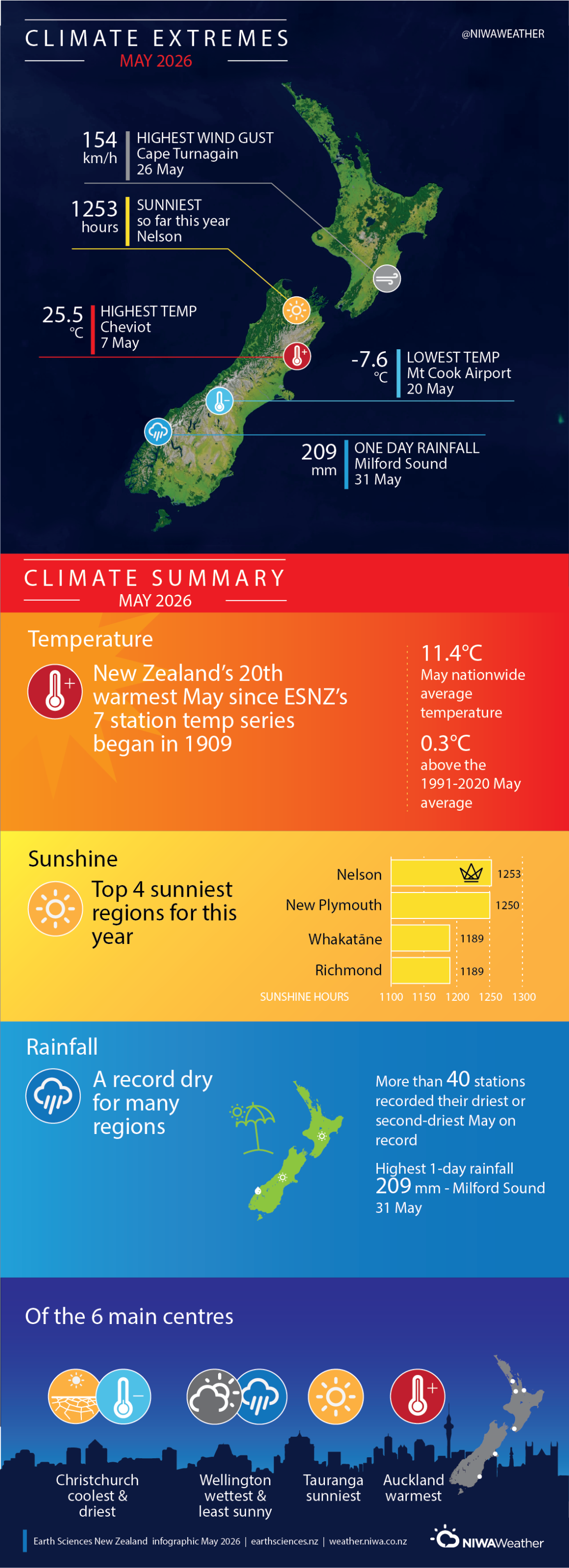
A record dry May for many regions
| Temperature | Temperatures were well above average (>1.20°C above average) or above average (0.51-1.20°C above average) in Northland, parts of Auckland, the Bay of Plenty, northern Gisborne, western Tasman, Marlborough, Westland, the Canterbury High Country about Arthur’s Pass and the Craigieburn Range, Bank’s Peninsula and Christchurch, Fiordland, Stewart Island, and some coastal parts of Otago. Near normal temperatures (±0.50°C) were recorded elsewhere. |
| Rainfall | Rainfall was below normal (50-79% of normal) or well below normal (<50% of normal) for the entire North Island outside of the Far North, much of Tasman, Marlborough, Canterbury, most of Otago, and Southland. Rainfall was above normal (120-149% of normal) for Wānaka. Elsewhere, near normal rainfall (80-119% of normal) fell in May. |
| Soil Moisture | At the end of autumn, soil moisture levels were considerably lower than normal in eastern parts of Canterbury from Cheviot to Orari. Soil moisture levels were lower than normal for the remainder of Canterbury, eastern and inland Otago, south Auckland, the Waikato, coastal Bay of Plenty, East Cape, Taranaki, and Manawatū-Whanganui. Soil moisture levels were higher than normal in southeastern parts of Marlborough, and coastal parts of the Tararua District. Near normal soil moisture levels were typical for the remainder of the country. |
Overview
May was dominated by high pressure and settled weather, which led to unusually dry weather for many areas, and overall near to above average temperatures. Despite a wet end to the month, nearly all of the North Island and much of the South Island experienced below normal rainfall. May was also a warm month, with generally above average to average temperatures across the country. ENSO (El Niño Southern Oscillation) neutral conditions continued through the month of May. Sea surface temperatures (SSTs) surrounding Aotearoa New Zealand were mostly above average. At the end of May, Marine Heatwave (MHW) conditions[1] were present about the lower South Island, stretching from Fiordland, coastal Southland and Stewart Island, coastal Otago, and just off the coast of South Canterbury.
The nationwide average temperature in May 2026 was 11.4°C. This is 0.3°C above the 1991-2020 May average, making it New Zealand’s 20th-warmest May since Earth Sciences New Zealand’s seven station temperature series began in 1909. The long stretches of high pressure generally led to warm afternoons and cool nights. One period of warmer-than-normal temperatures occurred ahead of a front that crossed the country from 6- 9 May. Additionally, very warm temperatures affected the country at the end of the month, as complex low pressure system brought in warm and moist air from 30-31 May.
It was a record setting dry month for many regions of the country. Almost 30 weather stations recorded their driest May on record (see rainfall section below). Rainfall was below normal (50-79% of normal) or well below normal (<50% of normal) for the entire North Island outside of the Far North in Northland, Western Tasman except about Tākaka, a majority of Marlborough, Canterbury, majority of Otago, Westland except about Haast, southern Fiordland, and Southland. Rainfall was above normal (120-149% of normal) for small portion of inland Otago about Wānaka. Elsewhere, near normal rainfall (80-119% of normal) fell in May.
Further highlights:
- The highest temperature was 25.5°C, observed in Cheviot on 7 May.
- The lowest temperature was -7.6°C, observed at Mt Cook Airport on 20 May.
- The highest 1-day rainfall was 209 mm, recorded at Milford Sound on 31 May.
- The highest wind gust was 154 km/h, observed at Cape Turnagain on 26 May.
- Of the six main centres, Auckland was the warmest, Tauranga was the sunniest, Wellington was the wettest and least sunny, Christchurch was the coolest and the driest.
- The sunniest four locations in 2026 so far are Nelson (1253 hours), New Plymouth (1250 hours), Whakatāne (1189 hours), and Richmond (1189 hours).
Download
[1] Defined as five or more consecutive days with SSTs above the 90th percentile for the time of year.