
A dry start to autumn for much of New Zealand
| Temperature | Temperatures were well above average (>1.20°C above average) for Central Otago and western Tasman. Above average temperatures (0.51-1.20°C above average) were recorded for Southland, Westland, remainder Otago, and the far south of Canterbury. Below average temperatures (0.51-1.20°C below average) occurred in the Wairarapa and about Gisborne, with near normal temperatures (±0.50°C) elsewhere. |
| Rainfall | Rainfall was well above normal (>149% of normal) or above normal (120-149% of normal) for Northland, western Auckland, coastal Bay of Plenty, the Coromandel, western Tasman, North Canterbury, and a portion of Southland. Rainfall was below normal (50-79% of normal) or well below normal (<50% of normal) for Central Otago, the Canterbury High Country, most of Westland, the Marlborough Sounds, a majority of Wellington, the Manawatū-Whanganui, Hawke’s Bay, southern Gisborne, Taranaki, inland Bay of Plenty, and most of the Waikato. Elsewhere, near normal rainfall (80-119% of normal) fell in March. |
| Soil Moisture | At the end of March, soil moisture levels were lower than normal in Hawke’s Bay, in the southern and eastern portions of the Manawatū-Whanganui, Taranaki, most of Central Otago, and Westland about Reefton. Soil moisture levels were higher than normal in Southland, the Canterbury low country, western Tasman region, about Mount Tongariro, the Bay of Plenty, the Coromandel, Auckland, and Northland. Near normal soil moisture levels were typical for the remainder of the country. |
Overview
March was a mild and mostly settled month for Aotearoa New Zealand, with one significant rain event in the upper North Island, brought on by a tropical low pressure system during the final week of the month.
Higher than average air pressure was experienced for the South Island and lower North Island, while lower than average air pressure dominated over the upper North Island in March.
ENSO (El Niño Southern Oscillation) neutral conditions continued through the month, though La Niña-like weather patterns persisted despite the demise of the recent La Niña event.
Sea Surface Temperature (SSTs) remained cooler than average for the month of March along the east and west coasts of the North Island and in the Cook Strait but were generally warmer than average around the South Island.
The nationwide average temperature in March 2025 was 15.8°C. This is right at the 1991-2020 March average. Aside from occasional fronts, March brought mainly settled weather until the third week of the month.
Colder than average temperatures were experienced for the first several days of the month, with several locations experiencing record or near-record cold maximum temperatures on 2 March.
Temperatures were generally warmer toward the middle and end of March. A tropical low brought in warm, humid air on 25-26 March.
With high pressure the dominant feature for the South Island and much of the lower and central North Island, drier than normal rainfall was experienced in most of these areas.
March rainfall was well above normal (>149% of normal) or above normal (120-149% of normal) in parts of Northland, western Auckland, the Coromandel, coastal Bay of Plenty, western Tasman, North Canterbury (around Christchurch and Waipara), and near Winton in Southland, while below normal (50-79% of normal) or well below normal (<50% of normal) affected much of the central and eastern South Island, and large areas of the lower North Island.
On 25–26 March, a deep subtropical low caused heavy rain, wind, and flooding across much of the country. A red warning for heavy rain was declared for Northland. From Northland to the Bay of Plenty, states of emergency, mass evacuations, power outages, emergency rescues and widespread road closures occurred.
Several locations experienced near record March daily rainfall totals (see Highlights and extreme events section for more details).
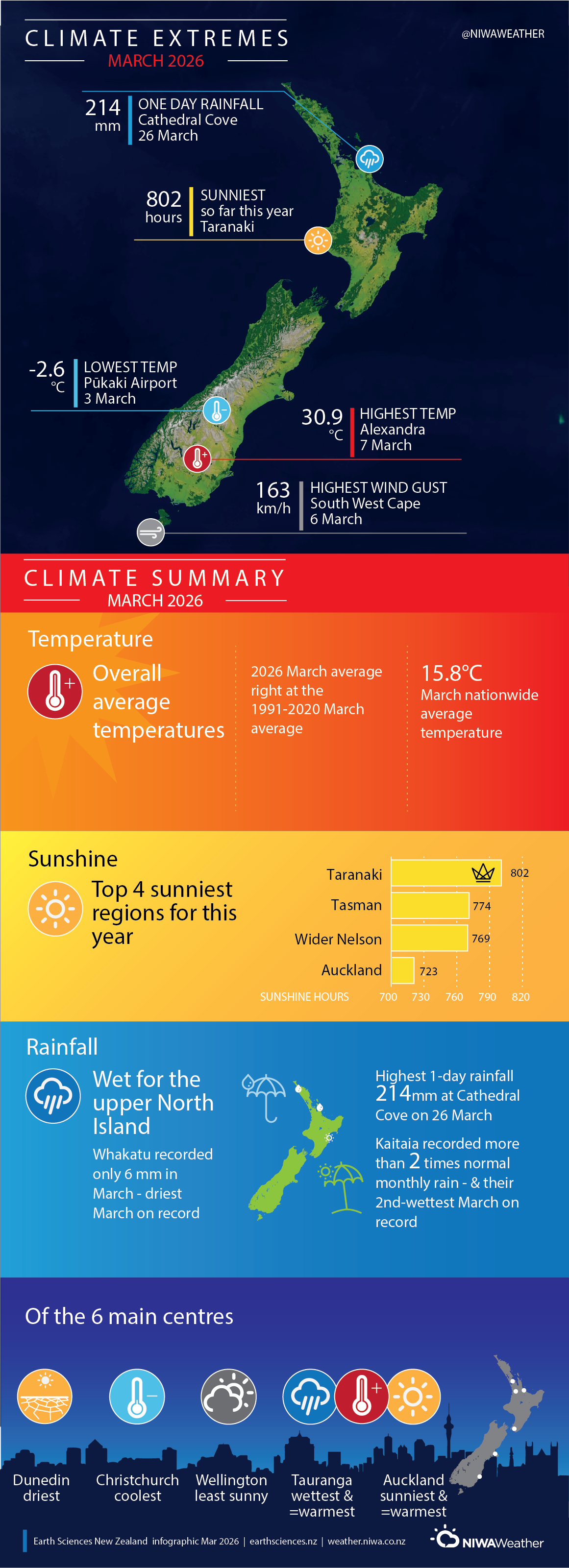
Further Highlights:
- The highest temperature was 30.9°C, observed at Alexandra on 7 March.
- The lowest temperature was -2.6°C, observed at Pūkaki Airport 3 March.
- The highest 1-day rainfall was 214 mm, recorded at Cathedral Cove on 26 March.
- The highest wind gust was 163 km/h, observed at South West Cape on 6 March.
- Of the six main centres, Tauranga and Auckland was the warmest, Auckland was the sunniest, Tauranga was the wettest, Dunedin was the driest, Christchurch was the coolest, and Wellington was the least sunny.
- The sunniest four regions in 2026 so far are Taranaki (802 hours), Tasman (774 hours), wider Nelson (769 hours), and Auckland (723 hours).