| Temperature | Temperatures were above average (0.51-1.20°C above average) or well above average (>1.20°C above average) for much of the country. Temperatures were near average (±0.50°C of average) for parts of Hawke’s Bay, Ruapehu District, inland Wairarapa, eastern Hurunui, southern Mackenzie District, and much of Central Otago. |
| Rainfall | Rainfall was above normal (120-149% of normal) or well above normal (>149% of normal) for northern, central and southern parts of the North Island, Tasman, Buller, Nelson, and Marlborough. Rainfall was below normal (50-79% of normal) or well below normal (<50% of normal) for Southland, Otago, Canterbury, and the eastern North Island from Napier to Castlepoint. |
| Soil Moisture | At the end of July, soil moisture levels were lower than normal for parts of Hawke’s Bay. Soil moisture was higher than normal for southeastern Marlborough, eastern Hurunui, Waimate, and eastern parts of Central Otago. Near normal soil moisture levels were typical for the remainder of the country. |
Overview
July 2025 mean sea level air pressure was higher than normal to the southeast of Aotearoa New Zealand, mostly near normal over the country, and lower than normal over the western Tasman Sea and southern Australia. This was associated with more northeasterly winds than normal for the country. ENSO-neutral (El Niño – Southern Oscillation) conditions remained present in the tropical Pacific, but trended towards La Niña-like conditions during the month. Sea surface temperatures (SSTs) around New Zealand were above average, particularly off the west coast of the country with Marine Heatwave (MHW) conditions experienced in these areas.
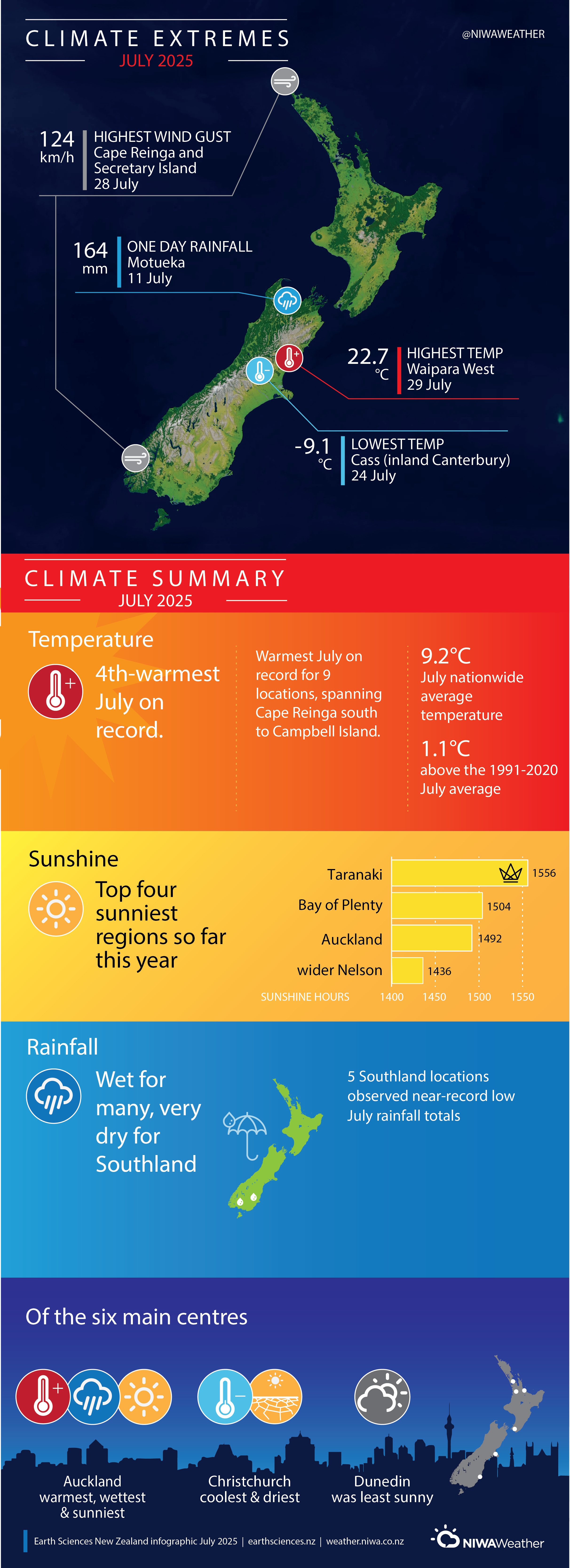
The mild start to winter for most of the country in June continued through July. The nationwide average temperature in July 2025 was 9.2°C. This was 1.1°C above the 1991-2020 July average, making it New Zealand’s 4th-warmest July since Earth Sciences New Zealand’s seven station temperature series began in 1909. Temperatures were above average (0.51-1.20°C above average) or well above average (>1.20°C above average) for most of the country. It was especially warm for Fiordland, Chatham Islands, and Arthur’s Pass, where mean temperatures were at least 2°C above the July average, respectively. Temperatures were near average (±0.50°C of average) for parts of Hawke’s Bay about Napier and Hastings, the Ruapehu District, inland Wairarapa, eastern Hurunui, southern Mackenzie District, and much of Central Otago.
Rainfall was above normal (120-149% of normal) or well above normal (>149% of normal) for much of Northland, Auckland, central and southern Waikato, Bay of Plenty, Wairoa, Taranaki, coastal Manawatū-Whanganui, western and southern Wellington, Tasman, Buller, Nelson, and Marlborough. Rainfall was below normal (50-79% of normal) or well below normal (<50% of normal) for Southland, Otago, Canterbury, and the eastern North Island from Napier to Castlepoint. Rainfall was near normal (89-119% of normal) for Gisborne, inland Wairarapa, and central and southern parts of the West Coast.
Further Highlights:
- The highest temperature was 22.7°C, observed at Waipara West on 29 July.
- The lowest temperature was -9.1°C, observed at Cass (inland Canterbury) on 24 July.
- The highest 1-day rainfall was 164 mm, recorded at Motueka on 11 July.
- The highest wind gust was 124 km/h, observed at Cape Reinga and Secretary Island on 28 July.
- Of the six main centres in July 2025, Auckland was the warmest, wettest, and sunniest, Christchurch was the coolest and driest, and Dunedin was the least sunny.
- The sunniest four locations in 2025 so far are Taranaki (1556 hours), Bay of Plenty (1504 hours), Auckland (1492 hours) and wider Nelson (1436 hours).
Download