
A recent study has advanced our knowledge of the growth patterns and age of black corals around New Zealand.
Black corals are a diverse group found in high abundance around Aotearoa New Zealand from coastal regions to the fiords and the deep sea.
For this study, colony samples were selected from the Earth Sciences NZ Invertebrate Collection from the Bay of Plenty, Hikurangi Margins, the Chatham Rise and Fiordland. They were then analysed using radiocarbon and uranium-thorium disequilibrium techniques.
The team found lifespans ranged from 71 years for Antipathella fiordensis, 1173 years Leiopathes, and 2221 years for the Antipatharia (genus not established) from the Chatham Rise.
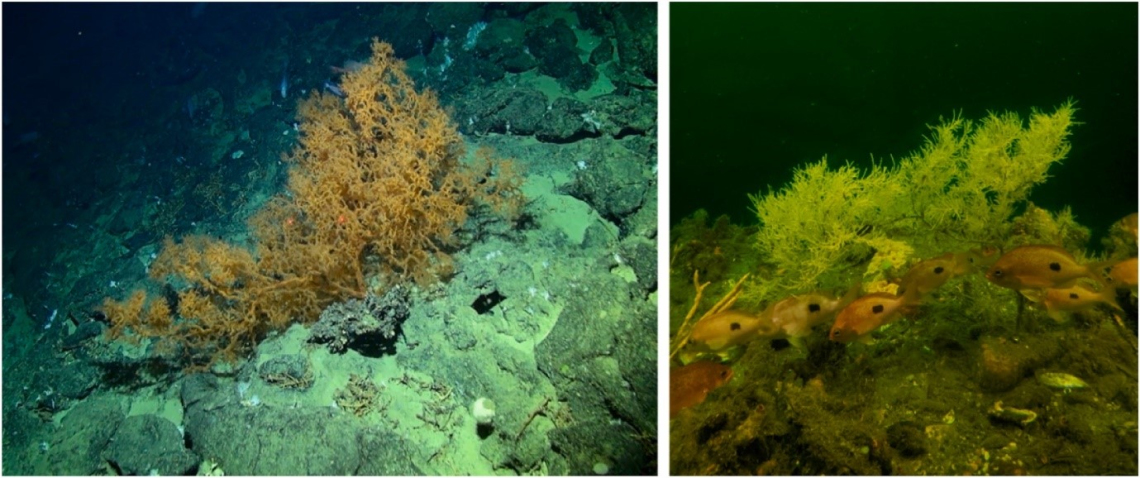
Earth Sciences NZ emerita scientist, Di Tracey says we have always known these shallow water and deepsea black corals are long-lived, but this recent collaborative paper led by Victoria University of Wellington PhD graduate Ashley Davis, adds significantly to the age dataset and knowledge of the physiology of the formation of black corals growth patterns.
“Understanding the potential for black corals to recover after disturbance such as fishing and mining requires knowledge of their longevity and growth rates,” she says.
The skeletons in the study showed radial growth rates ranging from 2.6 (Leiopathes sp.) – 126.7 μm/yr (A. fiordensis). High-resolution age-depth models (1.7–42.7 years/sample) were generated from U-Th age measurements leading to observations of an early life radial growth rate pattern that could provide further insights for black coral physiology.
“These data advance our knowledge of longevity for these corals, the variability in ages and growth rates between species and our regions, and their vulnerability to physical disturbances due to slow recovery rates. Information that is important for managing risk,” says Di.
The study was published in Deep-Sea Research Part II: Topical Studies in Oceanography and involved Victoria University of Wellington (Dan Sinclair and Ashley Davis), Earth Sciences NZ scientists Di Tracey, Erik Behrens, Peter Marriott, and Australian colleagues Stewart Fallon and John Hellstrom. This project received funding from MBIE.