New Zealand’s warmest June on record
| Temperature | Temperatures were well above average (>1.20°C above average) for most of the country. Temperatures were above average (0.51-1.20°C above average) for parts of Northland and Auckland. |
| Rainfall | Rainfall was above normal (120-149% of normal) or well above normal (>149% of normal) for the western Bay of Plenty, eastern parts of Waikato, the Wellington region, Tasman, Nelson, southern parts of the Mackenzie country, northern Otago, and central and western parts of Southland. Rainfall was below normal (50-79% of normal) for eastern parts of Northland, Auckland, Hawke’s Bay, northern and eastern Canterbury parts of the West Coast, and eastern Otago. |
| Soil Moisture | At the end of June, soil moisture levels were lower than normal for eastern parts of Canterbury and Otago, particularly about Christchurch and Dunedin. Soil moisture was higher than normal for eastern parts of Marlborough, and southern parts of the Mackenzie Country. Soil moisture levels were typically near normal for the remainder of the country. |
Overview
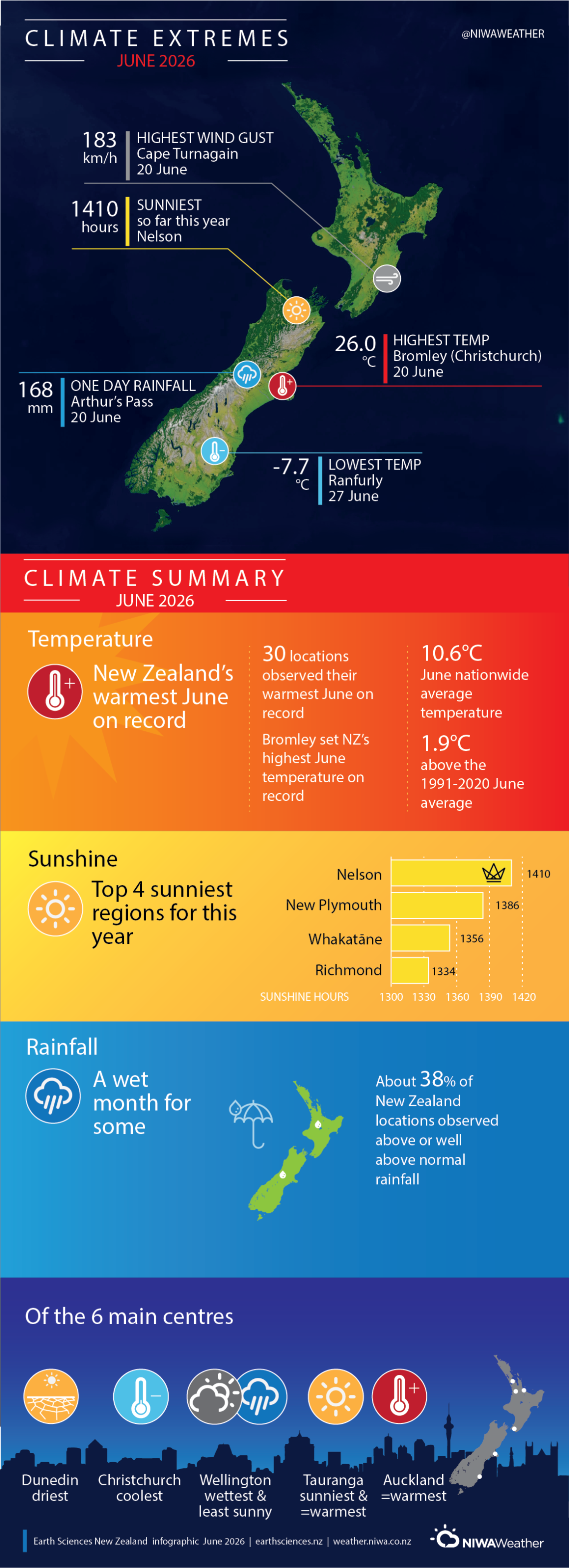
The nationwide average temperature in June 2026 was 10.6°C. This was 1.9°C above the 1991-2020 June average, making it New Zealand’s warmest June since ESNZ’s seven station temperature series began in 1909. Temperatures were well above average (>1.20°C above average) for most regions of the country, with many locations registering temperatures at least 2°C above average for the time of year. The month began on a very warm note, with a northerly airflow of subtropical origin delivering exceptionally high daily minimum temperatures across the country (see Highlights and extreme events section for further details). Anticyclones prevailed over and to the west of the North Island from 7-20 June bringing mostly settled and mild weather to much of the country. From 19-20 June, a strong and very warm northwesterly airflow saw temperatures surge over the South Island in particular. Notably, Bromley (Christchurch) reached a maximum temperature of 26.0°C on 20 June, which is New Zealand’s highest June temperature on record.
Rainfall was above normal (120-149% of normal) or well above normal (>149% of normal) for the western Bay of Plenty, eastern parts of Waikato, the Wellington region, Tasman, Nelson, southern parts of the Mackenzie country, northern Otago, and central and western parts of Southland. It was especially wet in Tara Hills and Masterton with these locations observing more than double their usual June rainfall. Rainfall was below normal (50-79% of normal) for eastern parts of Northland, Auckland, Hawke’s Bay, northern and eastern Canterbury parts of the West Coast, and eastern Otago. Well below normal rainfall (<50% of normal) occurred about Banks Peninsula. Rainfall was typically near normal (89-119% of normal) for remaining areas of the country.
By the end of June, El Niño conditions were present in the tropical Pacific, and sea surface temperatures (SSTs) surrounding New Zealand were mostly above average.
Further highlights
- The highest temperature was 26.0°C, observed at Bromley (Christchurch) on 20 June. This was a new record for New Zealand’s highest June temperature.
- The lowest temperature was -7.7°C, observed at Ranfurly on 27 June.
- The highest 1-day rainfall was 168 mm, recorded at Arthurs Pass on 20 June.
- The highest wind gust was 183 km/h, observed at Cape Turnagain on 20 June.
- Of the six main centres in June 2026, Auckland and Tauranga were the equal-warmest, Tauranga was the sunniest, Dunedin was the driest, Christchurch was the coolest, and Wellington was the wettest and least sunny.
- The sunniest four locations in 2026 so far are Nelson (1410 hours), New Plymouth (1386 hours), Whakatāne (1356 hours) and Richmond (1334 hours).