
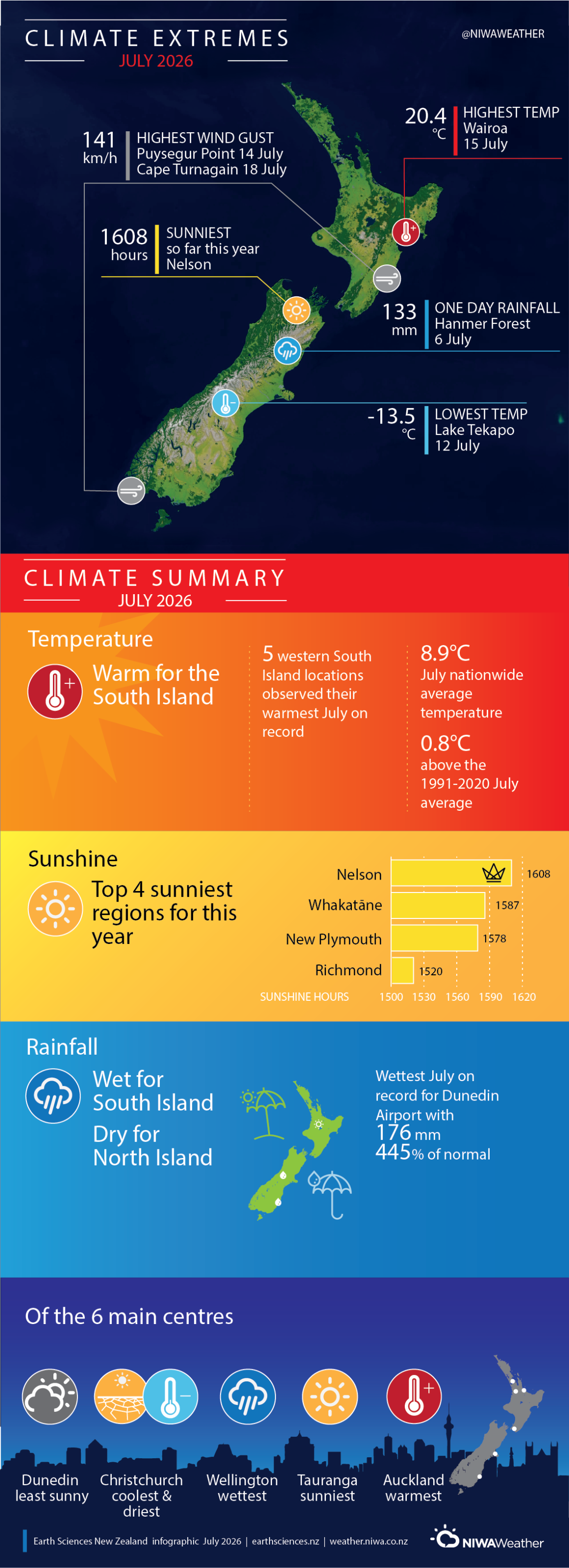
Warm and wet for the South Island, dry for the North Island.
Overview
July 2026 began on a settled note, with high pressure resulting in widespread clear weather and frosty conditions, particularly for southern and central parts of the South Island. A brief warm northerly airflow delivered record and near-record high daily maximum and minimum temperatures for southern and inland parts of the South Island. From 5-9 July, a broad area of low pressure prevailed over and east of Aotearoa New Zealand, delivering consecutive days of considerable rainfall to eastern parts of the country. Significant impacts resulted from the rain including damaging flooding, with a local State of Emergency declared in Waitaki, Kaikōura, and Wairoa, respectively (see Highlights and extreme events for further details). The middle and latter portion of July was often settled across the country, with a cool southerly airflow prevailing over the final week of the month.
El Niño conditions were present in the tropical Pacific atmosphere and ocean, and by all measures the event strengthened during the month – including the strongest atmospheric measurements on record for July. By the end of July, sea surface temperatures (SSTs) around New Zealand were mostly near or above average, particularly around much of the South Island and Tasman Sea with Marine Heatwave (MHW) conditions* experienced in these areas.
[*Defined as five or more consecutive days with SSTs above the 90th percentile for the time of year.]
The nationwide average temperature in July 2026 was 8.9°C. This was 0.8°C above the 1991-2020 July average, making it New Zealand’s 12th-warmest July since Earth Sciences New Zealand’s seven station temperature series began in 1909. Temperatures were above average (0.51-1.20°C above average) or well above average (>1.20°C above average) for most of the South Island. It was especially warm for Fiordland, Arthur’s Pass, and Greymouth where mean temperatures were at least 2°C above the July average, respectively. Temperatures were near average (±0.50°C of average) for much of the North Island, although there were below average temperatures (0.51-1.20°C below average) in localised inland parts of Waikato and the Bay of Plenty. It was a particularly cool month in Taupō where the mean temperature was 1.1°C below average.
Rainfall was above normal (120-149% of normal) or well above normal (>149% of normal) for most of Southland, Otago, southern, inland and northern parts of Canterbury, the West Coast, Marlborough, and Nelson. Several areas observed more than double their normal July rainfall including eastern Otago, and eastern parts of southern and northern Canterbury. Rainfall was below normal (50-79% of normal) or well below normal (<50% of normal) most of the North Island.
Further highlights
- The highest temperature was 20.4°C, observed at Wairoa on 15 July.
- The lowest temperature was -13.5°C, observed at Lake Tekapo on 12 July.
- The highest 1-day rainfall was 133 mm, recorded at Hanmer Forest on 6 July.
- The highest wind gust was 141 km/h, observed at Puysegur Point on 14 July, and Cape Turnagain on 18 July.
- Of the six main centres in July 2026, Auckland was the warmest, Christchurch was the coolest and driest, Tauranga was the sunniest, Wellington was the wettest, and Dunedin was the least sunny.
- The sunniest four locations in 2026 so far are Nelson (1608 hours), Whakatāne (1587 hours), New Plymouth (1578 hours) and Richmond (1520 hours).