
ENSO situation summary
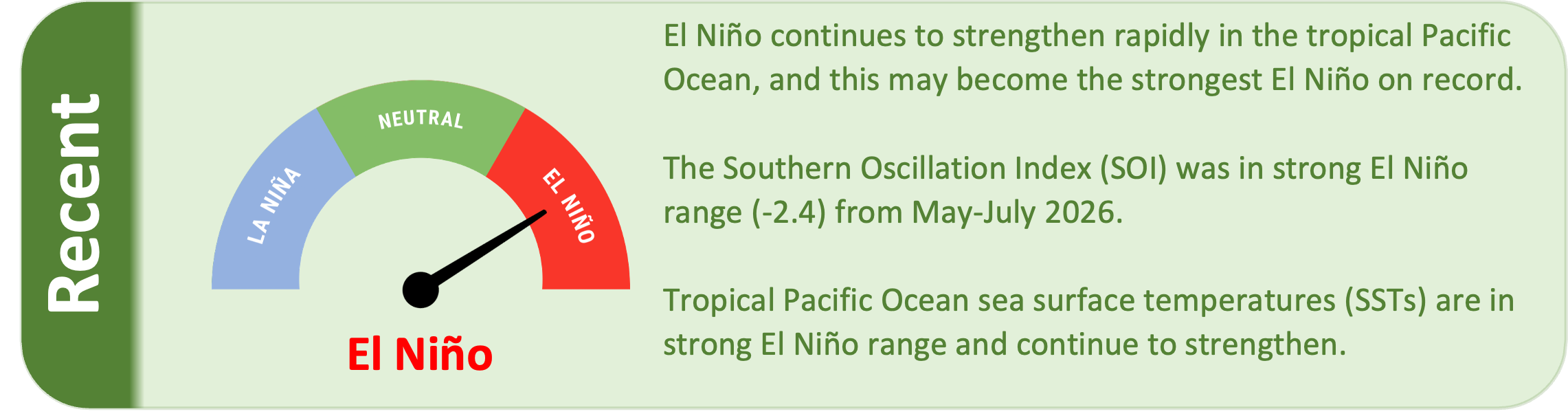
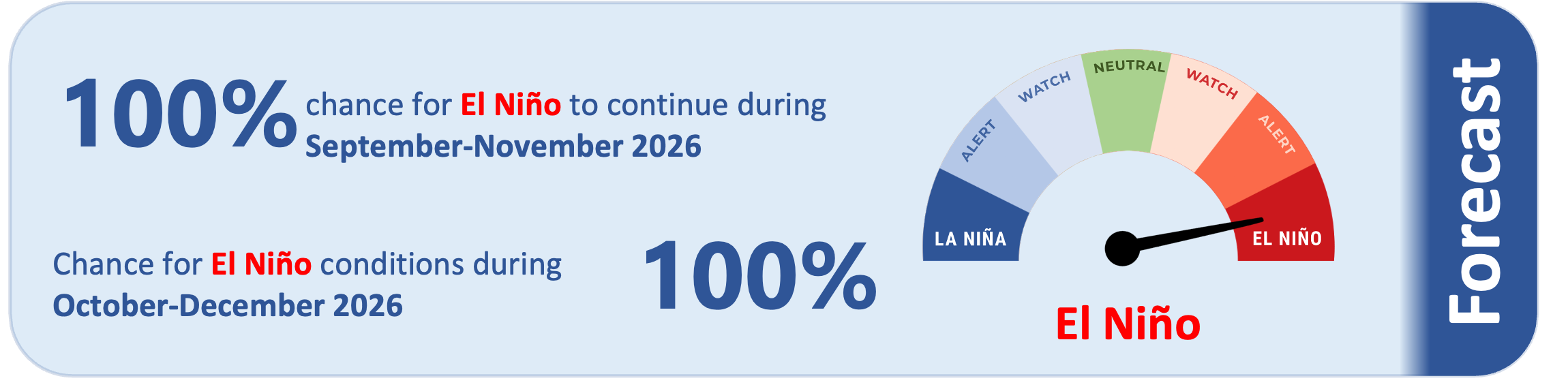
El Niño continues to strengthen rapidly in the tropical Pacific Ocean. There is a 100% chance that El Niño will continue during September-November, and a 100% chance that El Niño will continue through the rest of 2026. This El Niño has a good chance to become the strongest El Niño on record.
As of 17 August 2026, the 30-day NINO3.4 Index (in the central equatorial Pacific) was 2.48˚C, in strong El Niño range. The 30-day relative Niño 3.4 Index (RONI) was 1.77˚C, nearing strong El Niño range and reflective of the central equatorial Pacific being warmer than the average of
the global tropics.
The Southern Oscillation Index (SOI) was in strong El Niño range during May-July 2026 (-2.4), while the July value was -3.6 (the most negative SOI value ever recorded, dating back to 1876).
Subsurface ocean temperatures in the equatorial Pacific continue to be well above average in the eastern part of the basin, and upper-ocean heat content anomalies are well above average in the tropical eastern Pacific.
Extremely warm water is located in the eastern equatorial Pacific from the surface to depths of about 150 metres,
where temperature anomalies of 6-8°C are widespread, and approach 10°C in some places. This indicates that a strong El Niño is now occurring, and further strengthening to record levels is possible in the coming months.
During September-November, model guidance favours above normal or well above normal rainfall across eastern Micronesia and island groups along the equator. This may result in enhanced rainfall for island groups such as the Marshall Islands, Naoero, Kiribati, Tuvalu, Tokelau, and east toward the Marquesas.
Conversely, much drier than normal conditions are likely to occur for many island groups in a large arc from western Micronesia and Papua New Guinea east to the Tuamotu Archipelago. Most of these island groups will also have a high chance to be extremely dry during September- November (i.e. seasonal rainfall is expected to be below the 25th percentile). See pages 6-7 for more information.