
A mild and dry autumn for many parts of the country
| Temperature | Autumn temperatures were above average (0.51-1.20°C above average) for southern Southland, Fiordland, Dunedin, inland Canterbury, the West Coast, Tasman, parts of northern Waikato, and northern Northland. Temperatures were near average (±0.50°C of average) for the remainder of the country. |
| Rainfall | Rainfall was below normal (50-79% of normal) for coastal and central Otago, eastern parts of Canterbury especially about Christchurch and Banks Peninsula, Taranaki, Hawke’s Bay, Gisborne, and southern Waikato. Rainfall was above normal (120-149% of normal) or well above normal (>149% of normal) for Northland, northern Auckland, and eastern Marlborough. Rainfall was near normal (80-119% of normal) for the remainder of the country. |
| Soil Moisture | At the end of autumn, soil moisture levels were considerably lower than normal in eastern parts of Canterbury from Cheviot to Orari. Soil moisture levels were lower than normal for the remainder of Canterbury, eastern and inland Otago, south Auckland, Waikato, coastal Bay of Plenty, East Cape, Taranaki, and Manawatū-Whanganui. Soil moisture levels were higher than normal in southeastern parts of Marlborough, and coastal parts of the Tararua District. Near normal soil moisture levels were typical for the remainder of the country. |
Overview
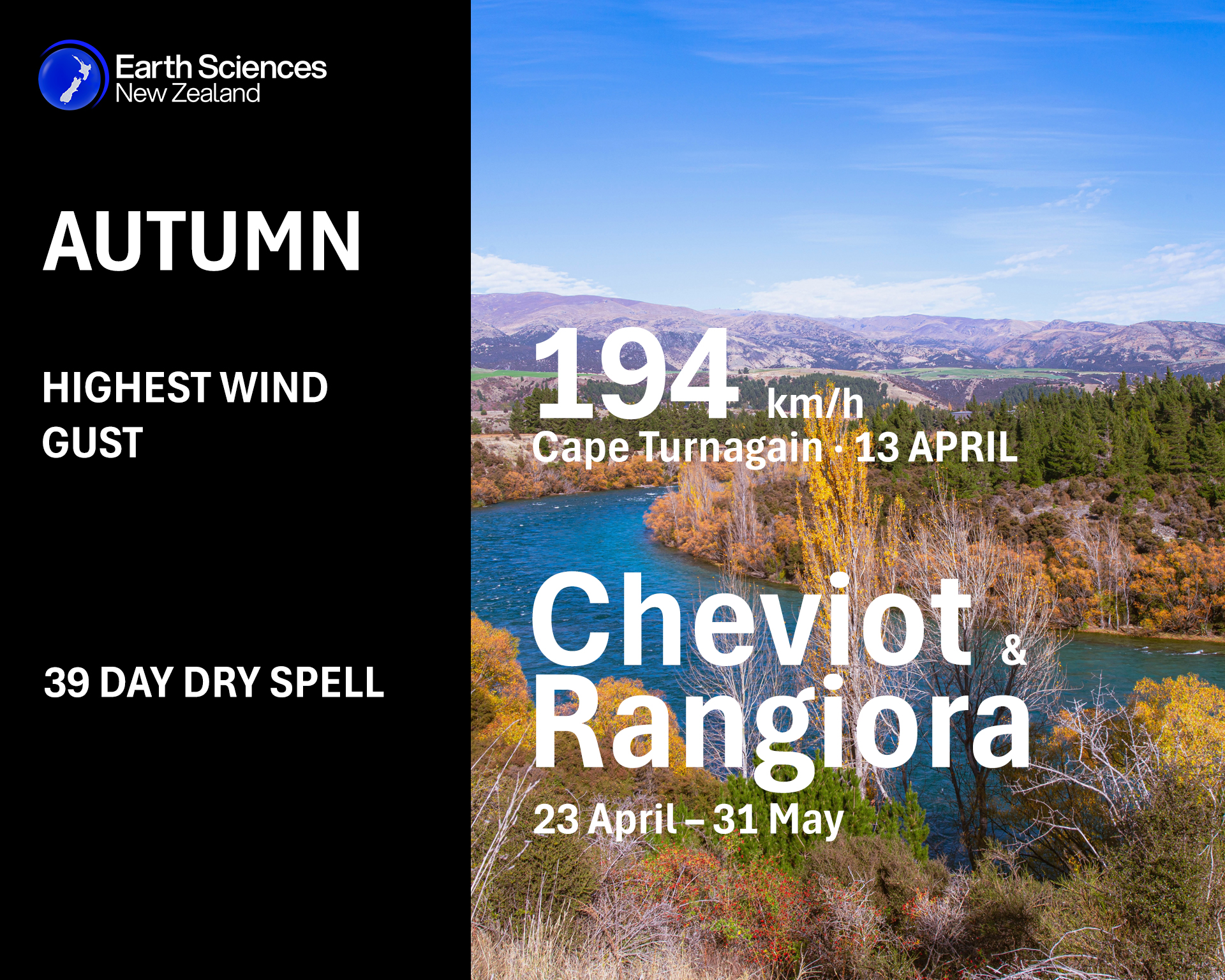
The first half of autumn was generally settled with slow-moving high pressure systems dominating over Aotearoa New Zealand. An unsettled period of weather impacted the northern North Island in late March, while the arrival of Cyclone Vaianu in mid-April heralded a week with bouts of heavy rain, localised downpours, and flooding for many parts of the North Island. Slow-moving high pressure systems returned during the back end of autumn, with extended periods of dry and calm weather across the country. Prolonged dry spells[1] occurred during May for many regions, but especially in Canterbury, where several locations registered dry spells of at least 35 days. ENSO-neutral (El Niño – Southern Oscillation) conditions were present in the tropical Pacific throughout autumn. Sea surface temperatures (SSTs) surrounding New Zealand were generally above average, particularly off the coast of the South Island. However, lower than average SSTs were observed near the east and west coast of the North Island in March, and these persisted near the eastern North Island throughout April.
The nationwide average temperature in autumn 2026 was 13.7°C. This was 0.3°C above the 1991-2020 autumn average, ranking as New Zealand’s 30th-warmest autumn since Earth Sciences New Zealand’s seven station temperature series began in 1909. Autumn temperatures were above average (0.51-1.20°C above average) for southern Southland, Fiordland, Dunedin, inland Canterbury, the West Coast, Tasman, parts of northern Waikato, and northern Northland. Temperatures were near average (±0.50°C of average) for the remainder of the country.
Autumn rainfall was below normal (50-79% of normal) for coastal and central Otago, eastern parts of Canterbury especially about Christchurch and Banks Peninsula, Taranaki, Hawke’s Bay, Gisborne, and southern Waikato. It was and especially dry autumn for Ranfurly, Clyde, and Akaroa, where rainfall totals were less than 50% of normal, respectively. Rainfall was above normal (120-149% of normal) or well above normal (>149% of normal) for Northland, northern Auckland, and eastern Marlborough. Rainfall was near normal (80-119% of normal) for the remainder of the country. By the end of autumn, very dry to extremely dry conditions were present[2] in eastern parts of Waimakariri and Selwyn Districts, as well as Christchurch.
Further Highlights:
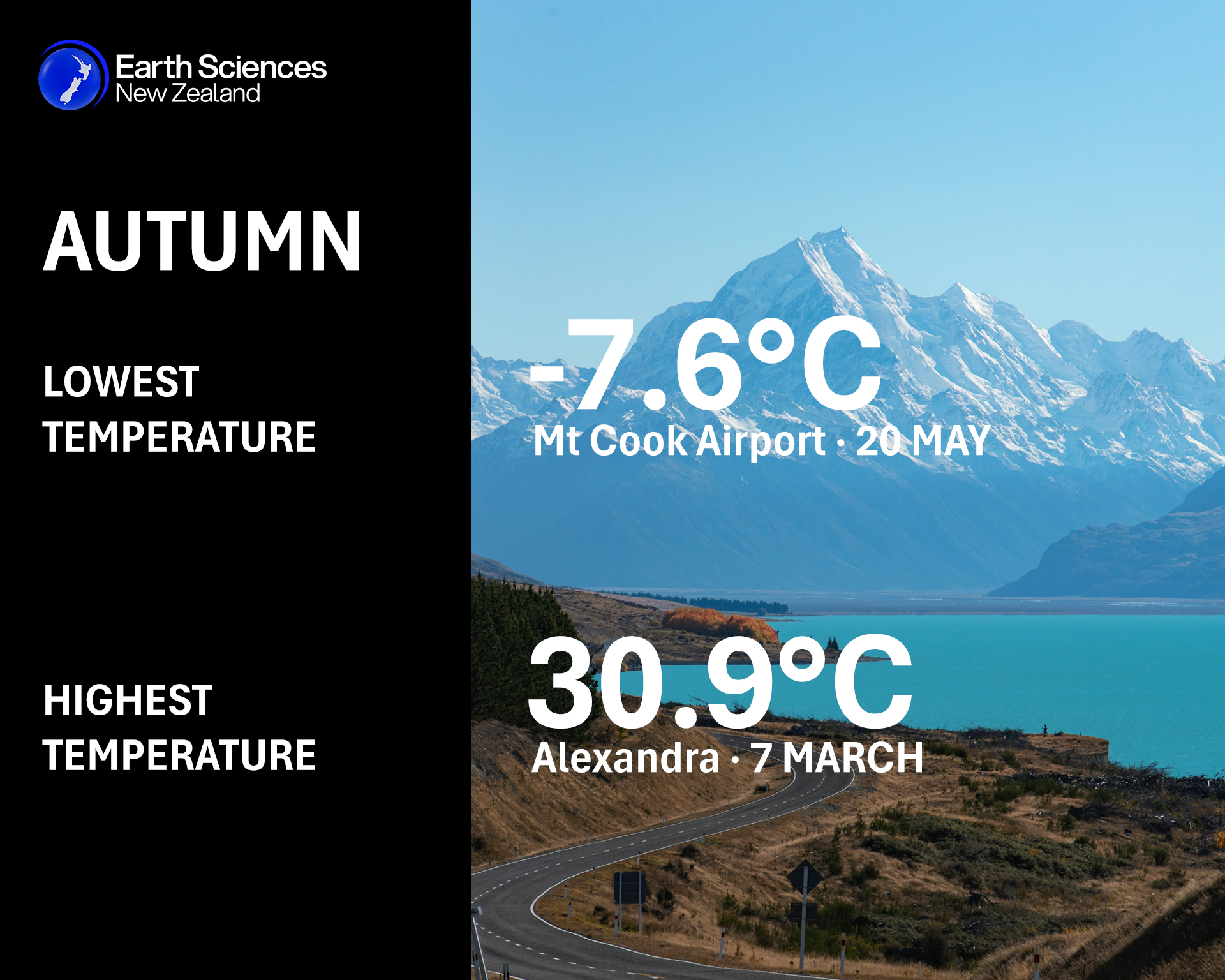
- The highest temperature was 30.9°C, observed at Alexandra on 7 March.
- The lowest temperature was -7.6°C, observed at Mt Cook Airport on 20 May.
- The highest 1-day rainfall was 214 mm, recorded at Cathedral Cove on 26 March.
- The highest wind gust was 194 km/h, observed at Cape Turnagain on 13 April.
- Of the six main centres in autumn 2026, Tauranga was the warmest and sunniest, Christchurch was the driest and coolest, and Wellington was the wettest and least sunny.
- The sunniest four locations in 2026 so far are Nelson (1253 hours), New Plymouth (1250 hours), Whakatāne (1189 hours), and Richmond (1189 hours).
Download
[1] Consecutive days with less than 1 mm of rain on any given day.
[2] According to the New Zealand Drought Index: https://niwa.co.nz/hazards/weather-hazards/new-zealand-drought-monitor