Underwater sound or the underwater ‘soundscape’ is a vital, yet often overlooked, component of aquatic ecosystems. It is a rich source of biological information, reflecting the many vital biological processes in a realm where other signals are often limited by light, visibility and accessibility. Soundscapes are not yet widely recognised for the breadth of information they hold, and as a key indicator of health of an ecosystem.
Why are we listening?
As part of the invasive clam Interventions Toolbox, University of Waikato acoustician Dr Jenni Stanley and Earth Sciences NZ freshwater ecologist Dr Michele Melchior, are exploring the potential use of sound as a tool to influence invasive gold clam behaviour or survival.
However, before any intervention can be considered, we must first understand the acoustic environments that clams currently experience.
By defining baseline soundscapes, including biological signals and human-generated noise, we can quantify exposure regimes and assess how additional acoustic interventions may alter ecosystem processes.
What are we doing?
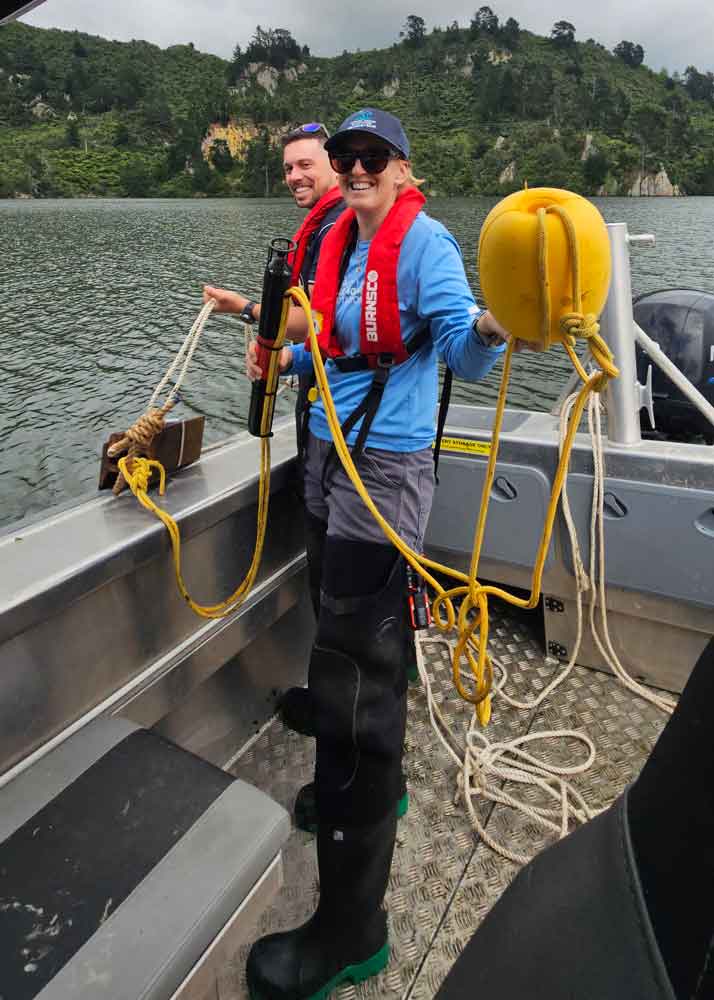
Ocean Instruments hydrophones (underwater microphones) have been deployed for passive acoustic monitoring (PAM) at several locations in Lake Maraetai, Lake Karāpiro and Lake Whakamaru. Sites span areas of high, low and no invasive gold clam densities.
The purpose of PAM is to assess ecosystem condition across these lakes relative to gold clam presence, define exposure regimes and better understand anthropogenic pressures.
These recorders capture sound from the location and surrounds continuously for up to 6 months.
Once recordings are complete, specifically written “Freshwater Soundscape Code” rapidly calculates values for salient soundscape properties. As well as identifying key contributors from biological, abiotic and anthropogenic sources. These metrics enable multivariate statistical analyses to quantitatively compare soundscapes across time and space.
By understanding how underwater soundscapes vary across lakes and clam invasion gradients, we build the ecological foundation needed to responsibly develop and test sound-based interventions as part of the Invasive Clam Interventions Toolbox.
Part of the Stopping the Gold Clam Endeavour programme: Interventions tools theme
Contacts: Dr Michele Melchior, Dr Jenni Stanley (UoW), Peter Williams