
In December, Earth Sciences NZ supported the Climate and Biodiversity Smart Marine Spatial Planning (CabSmart) project in Kiribati, contributing technical expertise to a significant ocean management initiative.
Funded by NZ MFAT, CabSmart is helping the Kiribati Marine Spatial Planning Coordinating Committee (KMSPCC) transition the Phoenix Islands Protected Area—one of the world’s largest marine protected areas—into an integrated spatial plan that incorporates climate impacts on the region’s exceptional biodiversity.
Using workshops, interviews and participatory processes, marine ecologists Tom Brough and Phoebe Stewart-Sinclair worked closely with the ministry of fisheries and ocean resources and wider stakeholders to identify and prioritise knowledge gaps.
The Earth Sciences NZ team are using in-house tools to deliver data needs, including forecasting the present-day and future distribution of marine species, representing areas of interest for fisheries and using systematic spatial prioritisation packages.
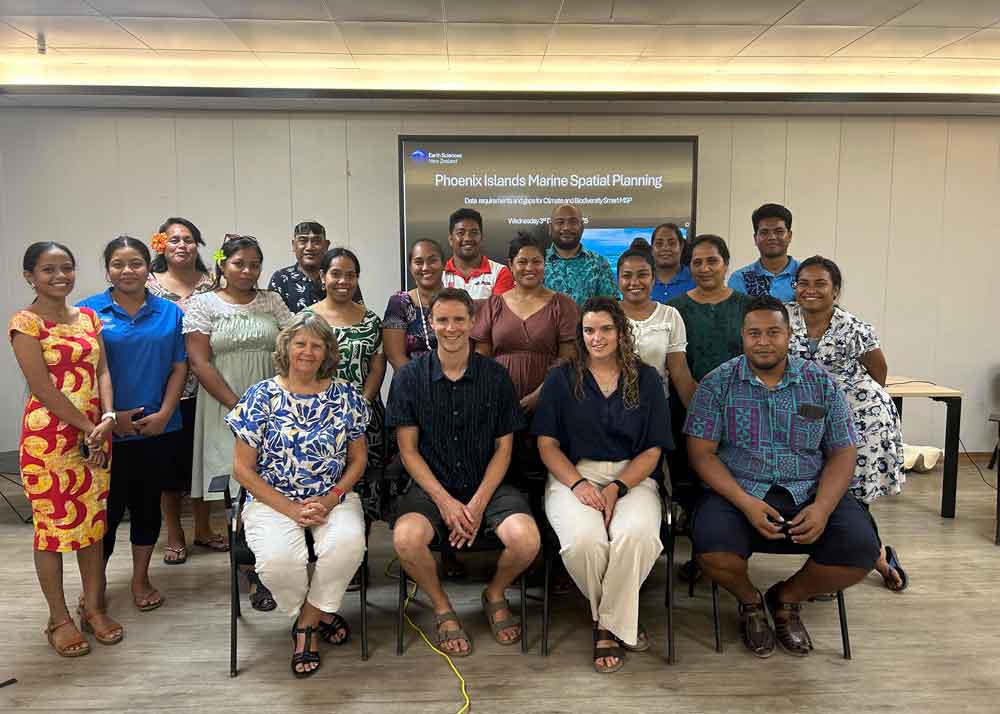
The project runs until mid-2026, and further visits will involve capacity development in the use of spatial prioritisation tools that will enable the KMSPCC to make informed decision on ocean zoning.
The visit provided valuable insights on the substantial challenges facing Pacific Island nations around integrating climate change into marine management, but importantly, found opportunities to future-proof decision making around the Phoenix Islands.
For more information: https://www.mfor.gov.ki/index.php/news/strengthening-ocean-governance-kmspcc-leads-stakeholder-engagement-in-the-line-islands