Key findings
Different economic assessment tools provide complementary insights into how Aotearoa New Zealand’s coastal lowland systems may respond to sea‑level rise and what adaptation options may be effective.
Under the Future Coasts Aotearoa programme, national‑scale modelling shows that sea-level rise can lead to costs to the agricultural sector, with impacts concentrated in the dairy sector—particularly in the Waikato. The model finds that maintaining existing drainage and defence schemes can substantially mitigate the losses. At a finer scale, regional real options analyses (ROAs) for the Lower Waikato and Lower Kaituna indicate that maintaining or upgrading flood protection is the most likely strategy, but that nature‑based options such as wetland restoration can be the least‑cost option under certain assumptions. For example, some environmental responses make sense from a whole‑of‑society perspective. However, they are not attractive investments to landowners because many benefits—such as ecosystem services and social wellbeing—are not captured by markets.
All analyses face important data and scope limitations, especially around sociocultural impacts, drainage scheme performance and groundwater and salinity processes. Consequently, more information is needed before adaptation decisions can be made with confidence.
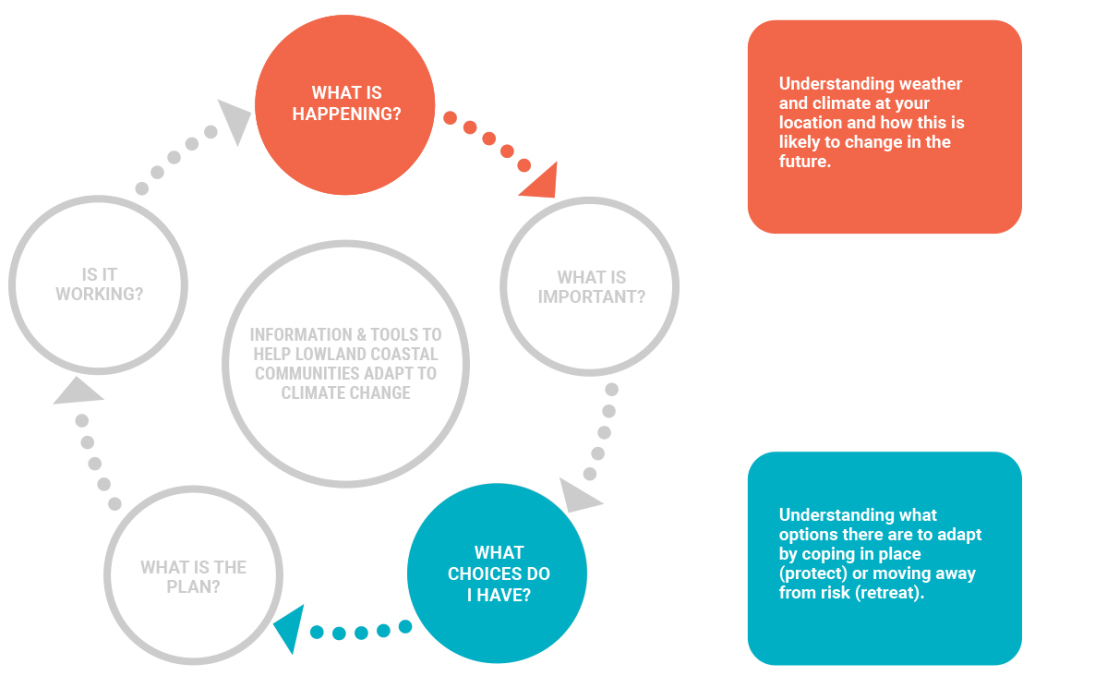
The Future Coasts Aotearoa programme and economic tools
Aotearoa’s coastal lowlands are flat, low‑lying areas adjacent to coasts and estuaries, valued for their ecological richness, cultural significance, and highly productive agriculture. Sea‑level rise will increase flood risk and place pressure on these landscapes and the communities that depend on them.
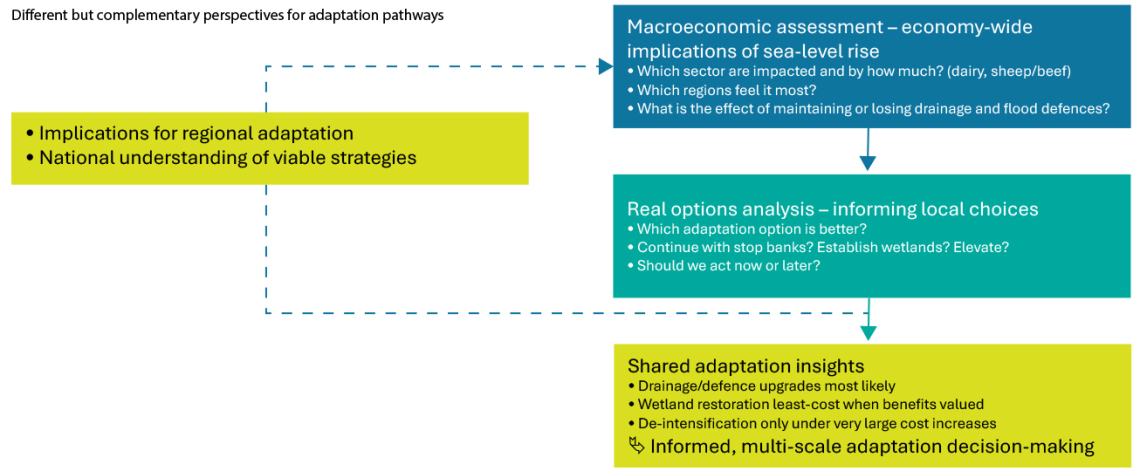
As part of the Future Coasts Aotearoa programme, the research team undertook three economic assessments to understand how coastal agricultural lowlands may adapt:
- A national macroeconomic assessment modelling farm‑level pasture production, land‑use change, and drainage/defence decisions, and their economy‑wide implications.
- Two regional real options analyses (ROAs) in the Lower Waikato and Lower Kaituna evaluating localised adaptation strategies under uncertainty, including the value of acting now versus delaying action.
These tools provide different but complementary perspectives on how socio‑economic systems may behave under sea‑level rise and what adaptation pathways may be viable.
What did we learn?
National‑scale macroeconomic assessment
- Maintaining and upgrading flood and drainage schemes would mitigate widespread land abandonment and limit agricultural losses under sea‑level rise.
- Losses are expected to be heavily concentrated in dairy farming—around four times the impact on sheep and beef—with the Waikato accounting for roughly 28 per cent of national losses.
- Deintensification of agriculture would only be likely if farmers faced very large increases in flood and drainage costs.
- Salinisation caused by rising sea levels is likely to accelerate losses in pasture-based farming as current approaches to mitigate sea level rise threats like inundation do not combat harm from rising salinity.
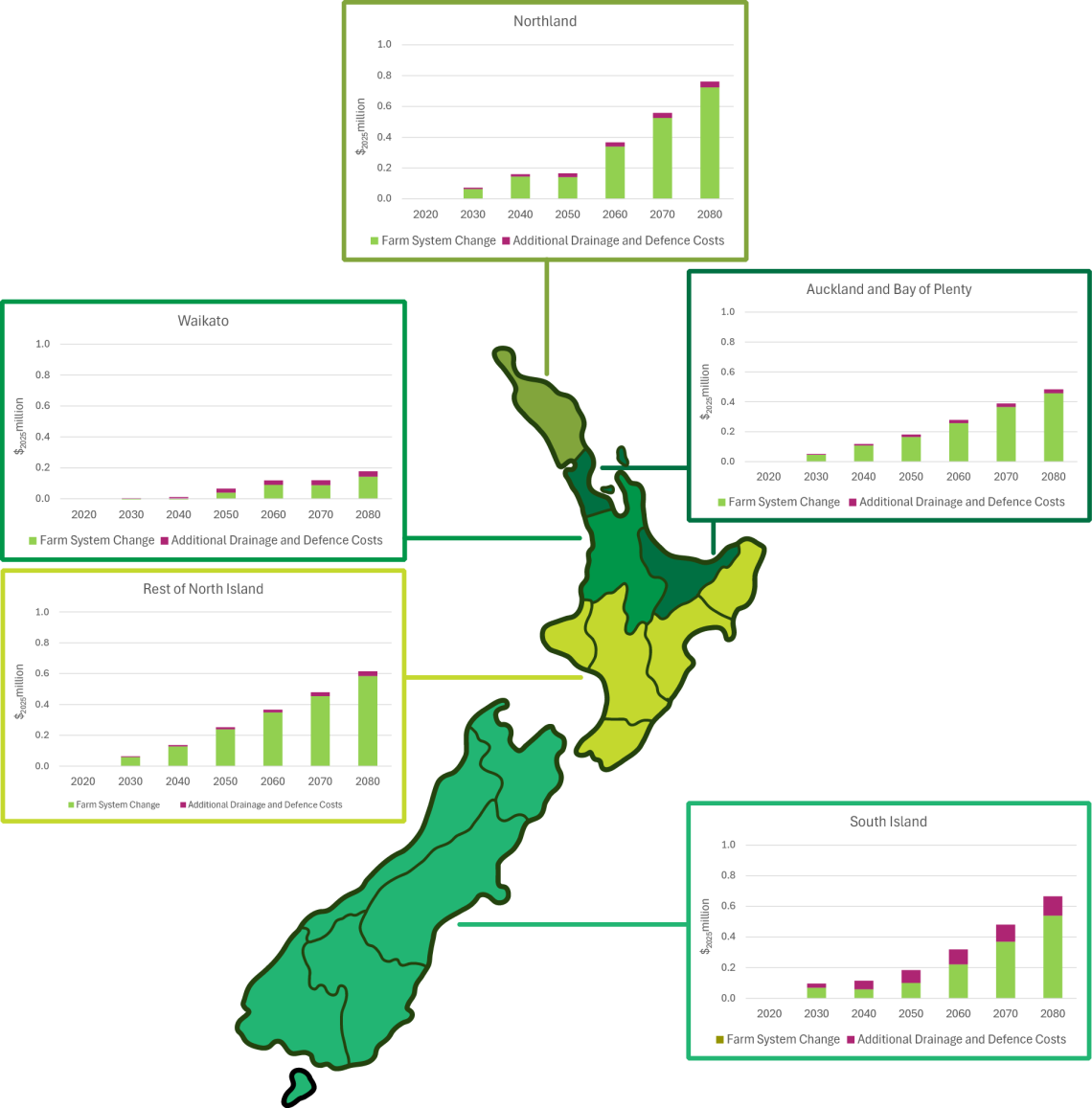
1 Earnings before interest, taxes, depreciation.
Regional Real Options analyses (Lower Waikato and Lower Kaituna)
- Not adapting to increased flood risk would lead to large long‑term costs in both regions.
- In the Lower Kaituna, wetland restoration could be the least‑cost option, provided that wetland benefits are monetised. Stop bank enhancement only becomes preferable under high confidence in severe sea‑level rise.
- In the Lower Waikato, maintaining and upgrading the stop bank system appears to perform most robustly under uncertainty. Wetland restoration appears to be viable but is riskier. Building elevation is generally uneconomic except for specific high‑value dwellings.
What does this mean?
Across all three assessments, a consistent message emerges: maintaining or enhancing drainage and defence schemes—especially in high‑value, high‑exposure regions such as the Lower Waikato—is the most likely adaptation strategy, unless spatial planning policies deliberately encourage other pathways. While reductions in agriculture only seem likely if farmers faced very large increases in flood and drainage costs, such increases may become inevitable as councils confront aging infrastructure.
Despite drainage and defence schemes being most likely adaptation strategy to sea level rise, the analyses also show that nature‑based solutions, particularly wetland restoration, could be the least‑cost option under certain assumptions. These options often deliver substantial ecosystem and social benefits but, because these benefits are not captured by markets, landowners have little incentive to adopt them—even when they are optimal from a whole‑of‑society perspective. These options warrant further investigation.
The assessments also highlight significant limitations:
- Key physical processes—rising groundwater, salinisation, inundation duration and velocity—were excluded due to data gaps.
- Economic data on wetland benefits is uncertain. The ROAs had to draw on other studies to represent environmental benefits from wetlands restoration.
- Social, cultural, and environmental impacts—including effects on Māori values, community preferences, biodiversity, and landscape character—were not incorporated, despite being critical to adaptation decisions.
- Drainage scheme cost and performance data is patchy, limiting confidence in long‑term projections.
What decision‑makers should consider next
- Improve information on drainage and defence systems. With aging infrastructure and rising sea levels, councils need robust data on the costs, performance, and long‑term viability of drainage and defence schemes to decide whether to maintain, upgrade, or replace them.
- Fill data gaps on wetland benefits and sociocultural impacts. Wetland restoration may provide substantial benefits—coastal protection, recreation, carbon capture—but evidence in the New Zealand context is limited. Better valuation of environmental and social outcomes is needed to support balanced decision‑making.
- Use broader decision‑making frameworks. Economic analysis alone is insufficient. Adaptation planning would benefit from:
- Environmental and social valuation
- Applied multicriteria analysis
- Tools that integrate cultural, ecological, and community values alongside economic outcomes
Together, these improvements would support more sustainable, equitable, and informed adaptation decisions for Aotearoa’s coastal lowlands.
This work was undertaken under the Future Coasts Aotearoa programme Research aim 2