Key findings
Adaptation simulations and serious games build the capacity of participants and facilitate meaningful, sometimes challenging, conversations:
- All Future Coast Aotearoa-developed games and adaptation simulations support player and participant learning. The online game is being used across councils, consultants, schools, and universities.
- Feedback from participants confirms that games can provide a safe and positive space to explore new ideas and learn.
- The games provide a means to understand, collect, and share information on people’s reflexive attitudes to adaptation in a non-threatening environment. The games collect more detailed and useful information about preferences and behavior than surveys or interviews because they position players in a resource-constrained decision-making environment. Evidence shows that people do not respond to hazards the way they think they would, as they are acting under pressure and with constrained choices.
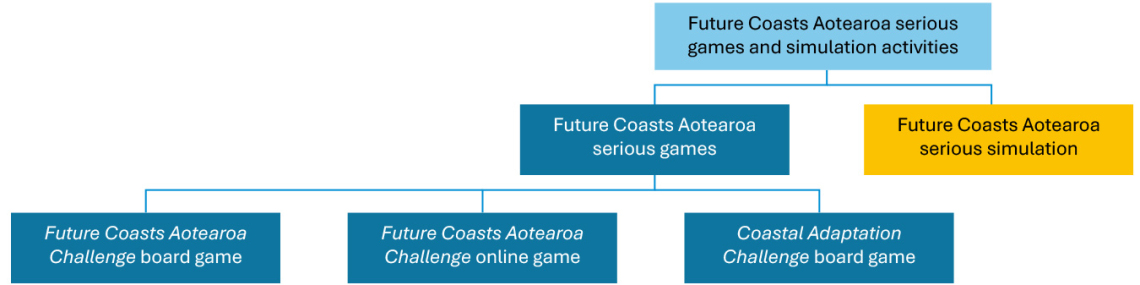
The Future Coasts Aotearoa programme and serious games
Aotearoa New Zealand’s coastal lowlands—defined as flat, low-lying plains adjacent to coasts and estuaries—are recognised for their ecological diversity, cultural importance, and productive agricultural use. Rising sea levels are expected to alter these areas, leading not only to environmental degradation but also to significant social and economic consequences. Earth Sciences NZ is undertaking the Future Coasts Aotearoa research programme to identify sustainable adaptive planning and decision-making frameworks for Aotearoa New Zealand’s coastal lowlands. As part of this initiative, a series of serious games and one adaptation simulation activity have been developed.
Feedback from participants confirm that games can provide a safe and positive space to explore new ideas and learn:
"Really helpful, including making the wish list and talking about the impact on other areas that I wouldn’t have thought about …"
"[When I came in, I wondered] what am I possibly gonna contribute? But the big power, having the power of the whaanau [like] what do I think? What do I feel? What have I seen? For me, this was perfect… I feel I contributed with my heart, not my brain"
"Bloody awesome… this was awesome. This gives us the perspective …helped build up ideas …"
Serious games
In the serious games, people play up to five different characters whose wellbeing and interests are threatened by climate change-driven increases in storm and flood risk, and rising water tables. Players must decide if and how they adapt to those changes as climate change progresses. The games take three forms:
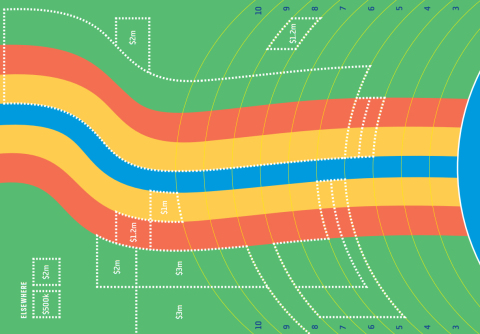
The Future Coasts Aotearoa Challenge is a board game for coastal community members to come together and jointly consider what climate change can mean in their lowland communities. This game is designed to represent a small rural community on the open coast.
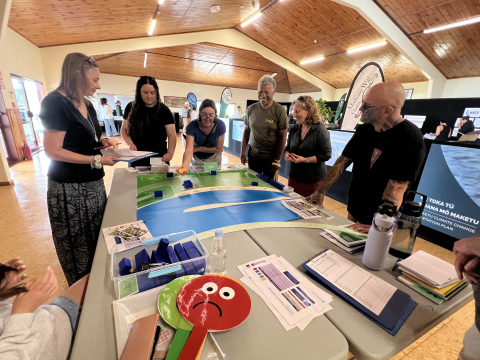
The Coastal Adaptation Challenge is a variation of the Future Coasts Aotearoa Challenge game that has been designed for communities near coasts including estuaries. The game was launched on a community day at Maketu in the Bay of Plenty.
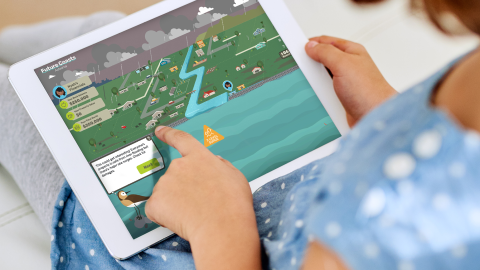
The Future Coasts Aotearoa multi-hazard serious game is an online animated game, based on the Future Coasts Aotearoa Challenge board game, where people can choose between different adaptation options. The game can be played anywhere in the world on tablets, laptops, and desktop computers. Alongside education, the purpose of the game is to collect data that allows us to understand people’s preferences for different types of adaptation options.
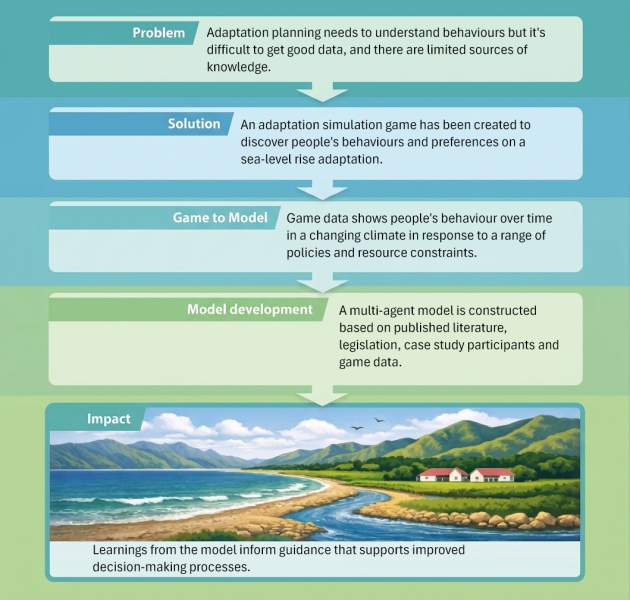
Information from the online game has been used to inform an agent-based model which simulates how property owners in risky coastal areas make adaptation decisions under different policies. Game-play data has been used to develop agents (different users that influence land use) and decision options for them.
The model simulates how long-term land use might turn out with rising seas if a local council favoured different policy options, like maintaining existing drainage schemes or wetlands restoration.
Adaptation simulation
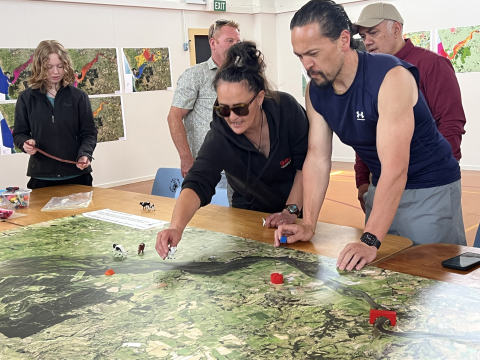
The Lower Waikato Simulation is an interactive activity, devised to enable iwi, hapū, and community members to visualise climate change impacts and brainstorm adaptive strategies using a large-scale map of their area. The simulation supports Lower Waikato iwi plan for changes like warming, river salinisation, rising groundwater and flooding.
What did we learn?
In-person board games
Plays of the Future Coasts Aotearoa Challenge board and online games demonstrate that people learn from the games and often amend their strategies if they see that earlier strategies can be unsuccessful (that is, where the characters end up destitute). In these cases, players often subsequently switch strategies from ‘sitting tight’ to more actively planning and staging their relocation to a safer location.
In the Coastal Adaptation Challenge in Maketu, adults tended to take the risk that hazards might not occur and chose not to invest in adaptation, while youth quickly asked about nature-based solutions for coastal defenses and unanimously established this response.
Online game plays
Game play reveals that raising floor levels tends to be the ‘go-to’ option for adapting when there are limited constraints upon players. It was found that adaptation choices were initially driven by players’ personal preferences. However, choices were later determined by the availability of adaptation options and their affordability, so players tend to be forced to move when finances are tight.
Agent-based model informed by Future Coasts Aotearoa Challenge online game play
Robust Decision Making was applied to the agent-based model to assess how well different adaptation strategies performed against a set of social, economic, and environmental performance metrics.
This showed that leaving early, before problems happen, was actually the worst choice because it cost a lot more than it helped. In the end, moving away was necessary for everyone, but picking the right time to do it was important to avoid negative results in different areas. The modelling showed that how we implement an adaptation strategy matters more than which strategy we choose. There is a narrow window (~30 years from 2040 – 2070) where retreat from the lowest lowlands becomes necessary. Including communities in decision-making—making sure they are actively involved rather than simply passive participants—helps maintain trust, satisfaction with decisions, and strong community bonds.
Adaptation interactive activity
Because adaptation can be constrained by finances, the Lower Waikato Simulation activity displayed that people of different backgrounds can be aspirational and collaborative when supported to brainstorm adaptation in a learning environment. Representatives of otherwise conflicting sectors (e.g., farming and environment) moved beyond traditional standpoints to discuss and sometimes agree on futuristic solutions. While many of the solutions are beyond today’s affordability or would take a long time to achieve, the collaboration generated a generally positive experience for participants and strengthened opportunities for relationship building and future collaboration.
Recommendations
Use serious games to reveal behavioral tendencies and inform community consultation and policy design. Our findings show that players often default to familiar or low‑effort adaptation options (e.g., raising floor levels), delay action until after impacts occur, or make choices strongly constrained by affordability and option availability. Because the patterns are so consistent (e.g., ~85% of individuals act only after experiencing impacts), games can serve as helpful behavioral diagnostics that help councils, agencies, and policymakers understand likely real‑world adaptation behaviors under different policy settings. Consequently, serious games can be helpful to, for example, explore where communities are likely to delay action, test how different incentives or constraints shift choices, and shape policies that reduce barriers to proactive adaptation.
Incorporate serious games into community engagement to build understanding, trust, and collaboration. Across all three games, participants engaged deeply with adaptation challenges, reconsidered their strategies, and demonstrated increased learning about long‑term climate risks. The Lower Waikato Simulation also showed that interactive activities can create a setting where people from conflicting sectors (e.g., farming and environment) move beyond fixed positions and collaboratively explore solutions. Serious games should be considered a safe, creative, and non‑confrontational engagement tool to build a shared understanding of risks, bring values and preferences to the surface, foster cross‑sector collaboration, and support the development of long‑term, community‑driven adaptation visions.
Use game‑generated data to inform modeling and scenario analysis by calibrating behavioral rules in adaptation models, running policy scenarios that reflect realistic human decision patterns, and supporting councils with evidence-based projections of future land use and adaptation behavior.
Serious games can help people talk more openly about the future and make climate change seem less scary. They might be considered to help make complex, uncertain futures more accessible, encourage hopeful and constructive discussion, and empower community members who may otherwise feel they have no voice or nothing to contribute.
For more information on the Future Coasts Aotearoa programme visit niwa.co.nz/future-coasts
This work was undertaken under the Future Coasts Aotearoa programme Research aim 2 and 3.
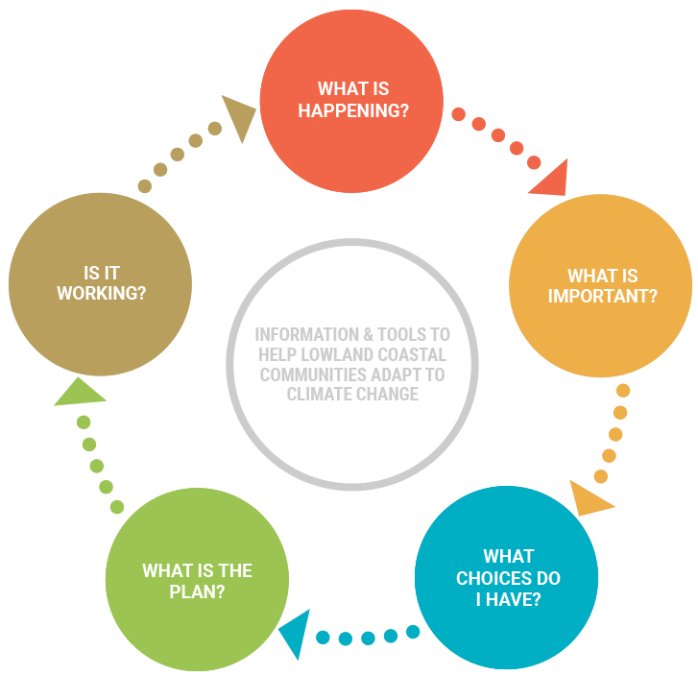
Note: Serious games are built to support the entire process of pathways thinking.