
Effective fish screen facilities work with fish behaviour, not against it.
Designing for fish behaviour and movement
Most of New Zealand’s native freshwater fish are small, bottom-dwelling species with relatively limited swimming ability. Many use river margins and stream beds for feeding, shelter, and refuge from fast flows or predators. Fish also move through rivers differently depending on their species, life stage, time of day, and season – making fish behaviour an important consideration in fish screen facility design.
Most fish naturally turn to face flowing water (positive rheotaxis), helping them hold position in rivers and respond to currents. Good fish screen facility design uses this behaviour to guide fish safely past water intakes and into bypasses where needed, rather than expecting fish to navigate unfamiliar or difficult engineered environments.
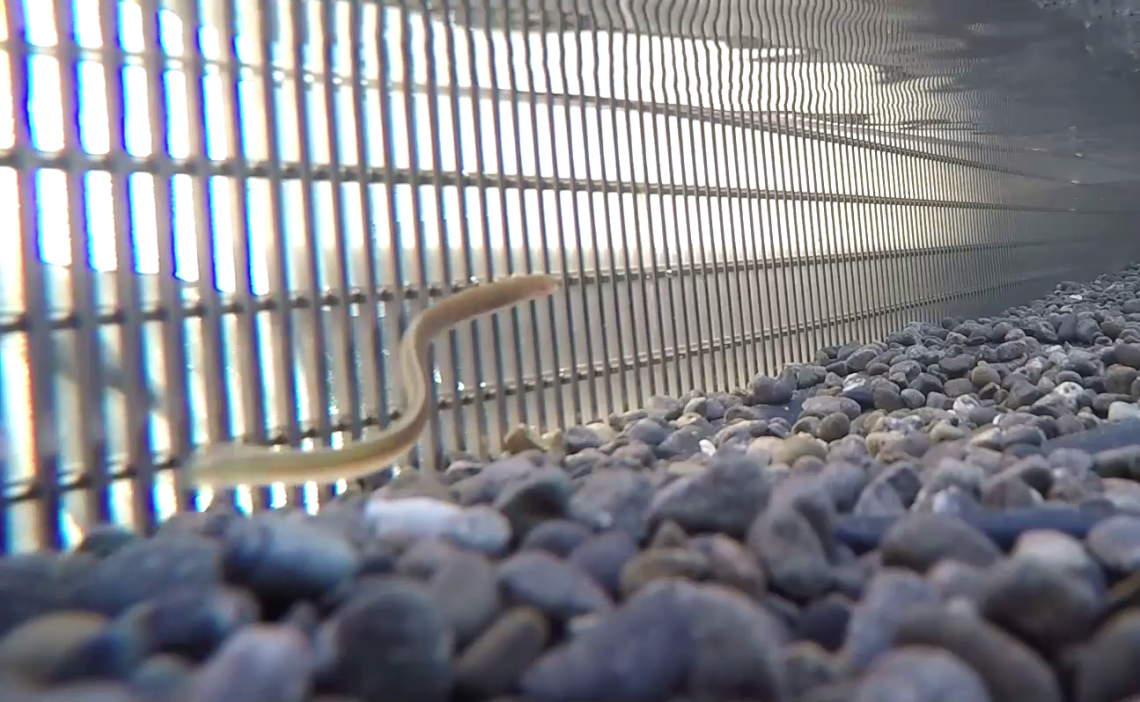
Fish screen facilities should generally avoid designs that require fish to:
| Avoid relying on fish to… | Why it matters |
| Make sharp or right-angle turns | Most fish do not naturally make sudden directional changes in fast-flowing water. |
| Move suddenly through the water column | Many species prefer particular depths and may avoid changing position. |
| Enter dark or enclosed spaces | Some fish are reluctant to move into pipes or shaded areas. |
| Actively avoid screens | Fish should be guided naturally by water flow, not expected to recognise hazards. |
| Swim through turbulence or drops | Turbulent water, vortices, and sudden drops can confuse, injure, or block fish movement. |
A successful fish screen facility creates conditions where the safe path is also the natural path, allowing fish to move through the system with minimal stress or behavioural change.
Fish move differently
Different fish species – and even different life stages of the same species – move through rivers in different ways. Some migrate upstream close to river margins or the stream bed, while others move downstream near the surface or shift position between day and night. Understanding where fish are likely to be in the water column, when they are moving, and in which direction helps determine the most suitable intake location and fish screen facility design.
| Fish group | Typical size | Movement | Where they are commonly found | Design consideration |
| Glass eels (juvenile longfin and shortfin eel) | < 60 mm | Upstream | Near the bottom and river margins | Avoid locating intakes near riverbanks where glass eels migrate. |
| Elvers (larger juvenile eels) | > 60 mm | Upstream | Middle and bottom of the water column | Consider bottom and mid-water movement pathways. |
| Juvenile whitebait and smelt | < 60 mm | Upstream | Near the surface and bottom | Facilities should account for movement across different depths. |
| Galaxiid larvae | < 20 mm | Downstream | Surface waters | Surface-oriented species may be vulnerable to poorly located intakes. |
| Larval whitebait, torrentfish and shrimp larvae | < 10 mm | Downstream | Surface by day, bottom at night | Fish behaviour changes between day and night. |
| Juvenile lamprey | < 120 mm | Downstream | Upper water column | Intake depth may influence entrainment risk. |
| Juvenile trout and salmon | < 25 mm | Downstream | Bottom (trout), mid-water (salmon) | Species-specific behaviour should inform facility placement and bypass design. |
Adapted from Charteris (2006). Fish behaviour varies between species, life stages, seasons, and river types, so local knowledge should always be considered when designing a fish screen facility.
Understanding which fish are present at a site can help guide intake location, screen placement, bypass design, and operating conditions. Information on fish distributions can be explored using the New Zealand Freshwater Fish Database, alongside local ecological knowledge and regional planning information.