
2025: New Zealand’s 4th-warmest year on record
| Temperature | 2025 was New Zealand’s 4th-warmest year on record, based on Earth Sciences New Zealand’s seven station series which begins in 1909. Annual temperatures were above average (0.51-1.20°C above the annual average) for most of the country, with well above average temperatures (>1.20°C above average) for parts of Northland and the Bay of Plenty. Annual temperatures were near average (±0.50°C of average) for the Mackenzie Basin and inland parts of Southland. |
| Rainfall | Rainfall was above normal (120-149% of the annual normal) for northern parts of Marlborough and Tasman, Nelson, Banks Peninsula, southern parts of the Mackenzie Basin, and Taupō. Rainfall was below normal (50-79% of the annual normal) for Hawke’s Bay and much of the Wairarapa. Near normal annual rainfall (80-119% of the annual normal) was typically observed elsewhere. |
| Soil moisture | From January to March, soil moisture levels became increasingly below normal for most of the North Island and northern parts of the South Island. By the end of May, soils were drier than normal for Whanganui, Manawatū, southern and central Hawke’s Bay, and southeastern Otago, but wetter than normal about eastern Canterbury and Marlborough. Soil moisture levels were near normal for most of the country by the end of winter. Below normal soil moisture levels emerged for eastern parts of the country during September, and these persisted through to the end of November. By the end of 2025, soils were wetter than normal about Gisborne, coastal parts of Hawke’s Bay, and Taranaki, with drier than normal soils emerging for northern parts of Northland. |
| Sunshine | Taranaki experienced New Zealand’s highest annual sunshine total during 2025 (2743 hours recorded at New Plymouth). |

Overview
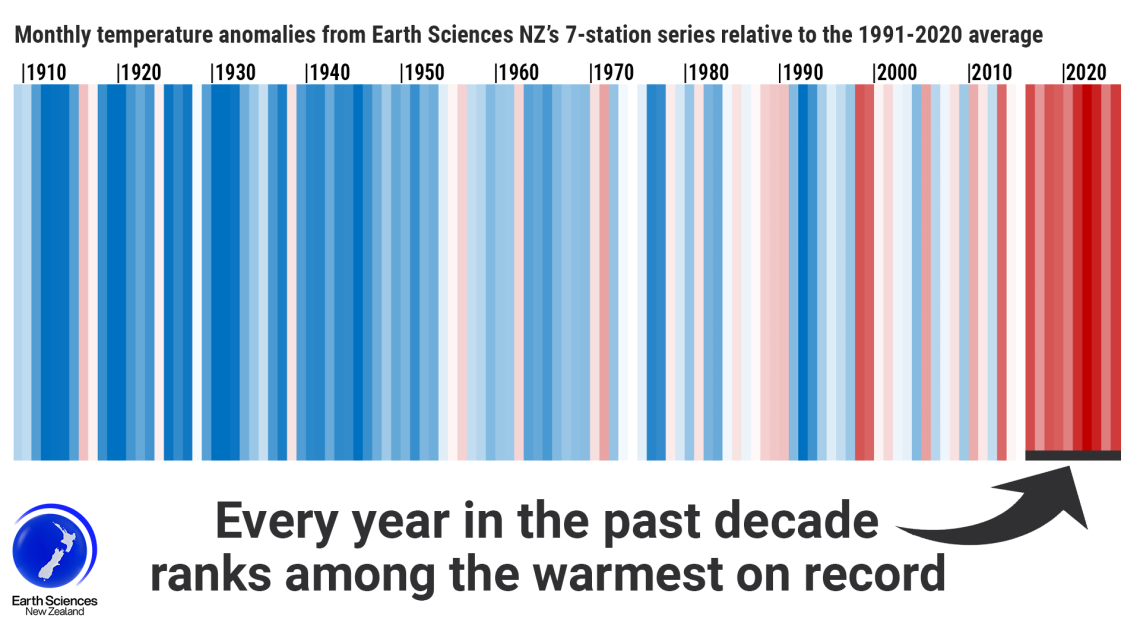
2025 was Aotearoa New Zealand’s 4th-warmest year on record. The 2025 nationwide average temperature calculated from Earth Sciences New Zealand’s (ESNZ) seven station series was 13.51°C, being 0.77°C above the 1991-2020 annual average. Four of New Zealand’s five warmest years on record have occurred since 2021 (Figure 1). The ongoing warming trend observed both locally and globally is consistent with human-caused climate change. This is largely driven by human greenhouse gas emissions. Atmospheric carbon dioxide (CO2) levels continue to rise, surpassing 423 ppm at ESNZ’s Baring Head monitoring station during 2025.

Figure 1. New Zealand 7-station annual temperature, minus the 1991-2020 average.
Data from ESNZ’s seven station series shows nine months of 2025 had temperatures that were well above average (>1.2°C above the monthly average) or above average (0.5-1.2°C above the monthly average). November and April were the country’s warmest months compared to normal, at 2.2°C and 1.8°C above the 1991-2020 monthly average, respectively. Meanwhile, January was relatively cool, with a mean temperature 0.8°C below the 1991-2020 monthly average.
ENSO-neutral (El Niño – Southern Oscillation) conditions prevailed in the tropical Pacific for most of the year, before transitioning to a La Niña during October. La Niña conditions remained for the rest of the year. New Zealand had a relatively settled start to the year, with dry conditions for most parts of the country from January to March. The exception was eastern parts of the South Island where both January and March were wetter than usual. In early-March, the Minister for Agriculture classified drought conditions in the Northland, Waikato, Horizons, and Marlborough-Tasman regions as a medium-scale adverse event. This was an extension of the original drought classification that was made for Taranaki in late-February 2025. By mid-to-late April, the dry conditions had eased for most of these regions, although unusual dryness persisted in parts of Waikato until early-to-mid May.
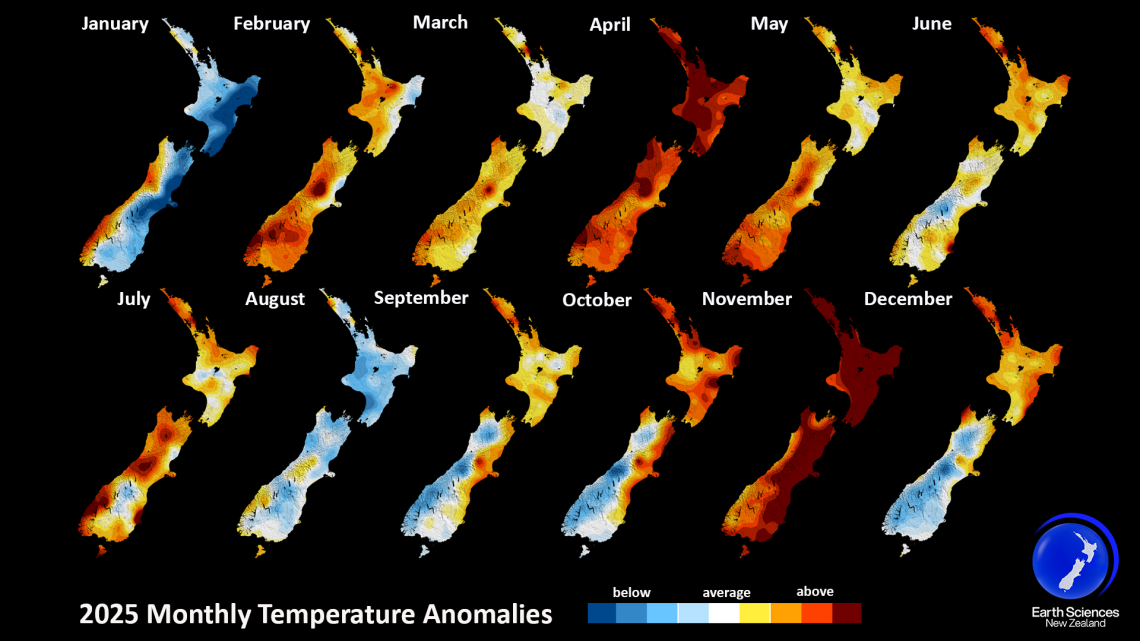
2025 Monthly temperature anomalies
Autumn was characterised by more northeasterly winds than normal, which contributed to warmer than usual temperatures, especially during April. Warmer than usual temperatures persisted through the remainder of the year, except for August when calm, clear weather brought cooler than usual overnight minimum temperatures to most of the country. A Sudden Stratospheric Warming event developed over Antarctica in September, coinciding with persistent and occasionally very strong west to northwesterly winds from September to December. This was reflected in higher than usual rainfall for the western South Island during these months, with unusually dry conditions observed in eastern parts of the country.

2024 Monthly rainfall anomalies
Several extreme rainfall events occurred throughout the year, with three local state of emergency declarations due to the impacts of flooding (Selwyn District, Christchurch, and Banks Peninsula in April-May; Nelson-Tasman and Marlborough in June; and Nelson-Tasman in July). Another state of emergency was declared in Southland and Clutha in late-October due to a severe and damaging wind event. More than 25,000 properties were without power, with many parks, reserves, cemeteries and playgrounds closed for several weeks due to downed and damaged trees.
In 2025, local sea surface temperatures (SSTs) were relatively warm, remaining almost exclusively above normal throughout the year. The exception was for SSTs near the western North Island which were briefly cooler than normal from mid-January to early-February. Local 30-day average SSTs were most unusually warm towards the end of the year, peaking at around 2.4°C above average off the north of the North Island from mid-to-late-December. Marine heatwave conditions – defined as five or more consecutive days with SSTs above the 90th percentile for the time of year – were common in local SSTs during the year, but especially off the west of the country during the second half of the year. Relatively warm SSTs coincided with warmer than usual air temperatures. Most notably, New Zealand observed its warmest November and 5th-warmest April on record.