
This study draws on two consecutive years of dive-based quadrat surveys (2024–2025) across two hydro-lakes Karaapiro and Maraetai, to track population dynamics of the invasive gold clam and explore its interactions with the declining native freshwater kaakahi.
Aquatic invasive species pose major threats to freshwater ecosystems, yet the mechanisms underpinning their spread and ecological impacts are often unclear during the early stages of establishment.
Invasive clams (Corbicula fluminea) were first confirmed in Aotearoa in May 2023 at Lake Karaapiro, and by the end of that year had been visually identified throughout much of the Waikato River. In 2024, ESNZ, commissioned by MPI, carried out baseline population surveys at five sites in Lakes Karāpiro and Maraetai. The programme expanded in 2025 under MBIE funding to include four additional sites, improving spatial coverage and capturing a wider range of habitats.
The annual dive surveys of Corbicula fluminea (invasive gold clam) in Lakes Karaapiro and Maraetai aim to extend our understanding of the species’ spatial distribution and to provide insights into how populations are changing over time. Comparing results from two consecutive years also allows us to track shifts in population density, assess changes in size structure between juveniles and adults, and evaluate overall population trends. Together, these objectives build a clearer picture of invasion dynamics and inform management strategies for this invasive species.
The research team examined co-occurrence patterns, relative densities, and biomass of both bivalve species across nine sites, spanning a range of habitats and depths (1–15 m). While C. fluminea densities increased at some sites between years, particularly in mid-to-deep zones (9–12 m), kaakahi remained patchily distributed, with peak densities at mid-depth habitats (4–6 m) and possible declines at some previously occupied sites. At fine spatial scales, C. fluminea density was negatively related to kaakahi presence. Notably, quadrats with high mussel density almost never supported high clam density, although clams were frequently found in quadrats with few or no mussels. This triangular distribution pattern suggests potential space- or resource-mediated exclusion, consistent with the “neighbour exclusion” hypothesis. However, the negative association weakened when data were aggregated across sites or lakes, supporting findings by Vaughn and Spooner (2006) that invasive-native interactions may be scale-dependent.
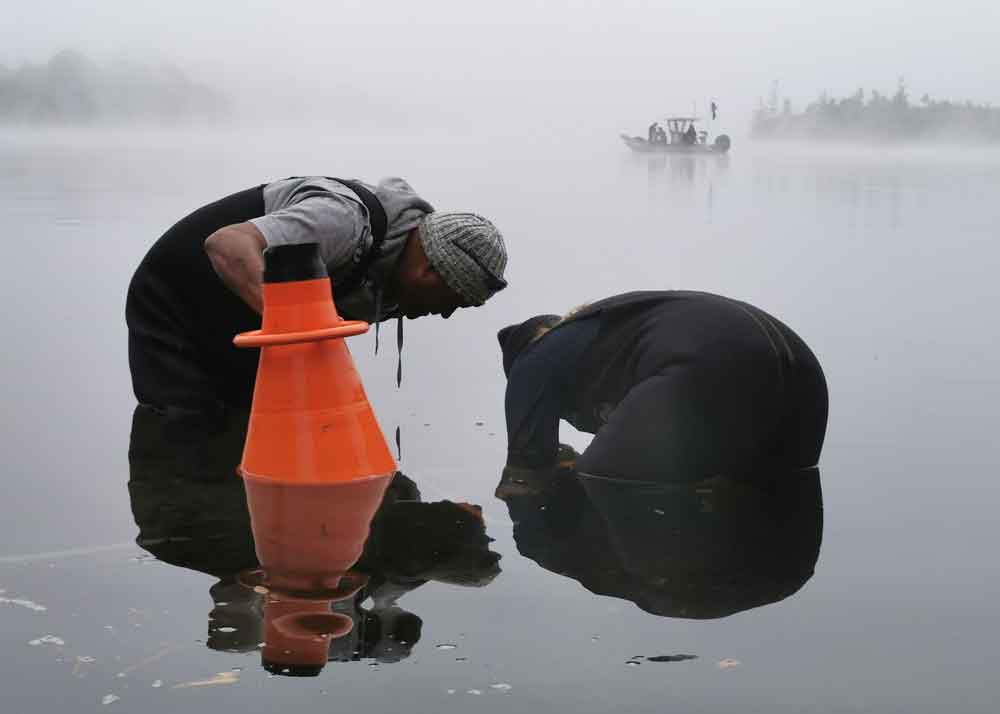
General results from 2025 survey
- Corbicula fluminea was detected at all nine survey sites and depths (15 m) in 2025, including the most upstream sites (added sites) in both Karaapiro and Maraetai.
- Overall, densities varied between sites and depths, with hot spots such as the boat ramp at Maraetai and Waipuke park at Karaapiro remaining high, showing some increases since 2024, while others remained low or stable.
- Dense clam aggregations occurred in deeper zones, across a range of substrates, including under invasive macrophyte beds - although habitat use varied by site.
- Size-frequency plots indicate ongoing recruitment, with some sites showing shifts in size classes and signs of a change from new, younger populations to more established populations.
- Altogether, the variation in clam and kaakahi presence across depths and sites reinforces the need for site-specific management strategies.
- Findings are helping to guide future research by highlighting priorities such as understanding habitat use and preferences, improving our ability to predict population dynamics, and identifying effective points for intervention.
These findings highlight the importance of monitoring fine-scale ecological interactions at the invasion front to predict long-term impacts and inform freshwater biosecurity management in Aotearoa–New Zealand.