
Tropical cyclone outlook summary for the Southwest Pacific Islands
- Our assessment of tropical cyclone (TC) activity for the coming season indicates normal to below normal activity. [Tropical cyclones are categorised in strength from 1 to 5, with 5 being most intense. Tropical cyclones that reach category 3 or higher are classified as severe, with mean (10 minute) wind speeds of at least 119 km/h.]
- Five to nine named TCs could occur in the Southwest Pacific from November 2025-April 2026. The long-term average number of named TCs per season between 1991-2020 is around nine.
- TCs have a significant impact across the Southwest Pacific, with the season starting in November and lasting through April. For the coming season, significant differences are expected between the western and eastern halves of the basin.
- The risk of impact from a TC is expected to be higher near the Coral Sea, and around New Caledonia and Vanuatu, as illustrated in Figure 1. Normal to reduced risk is anticipated for the central part of the basin, and reduced risk is expected for the eastern part of the basin.

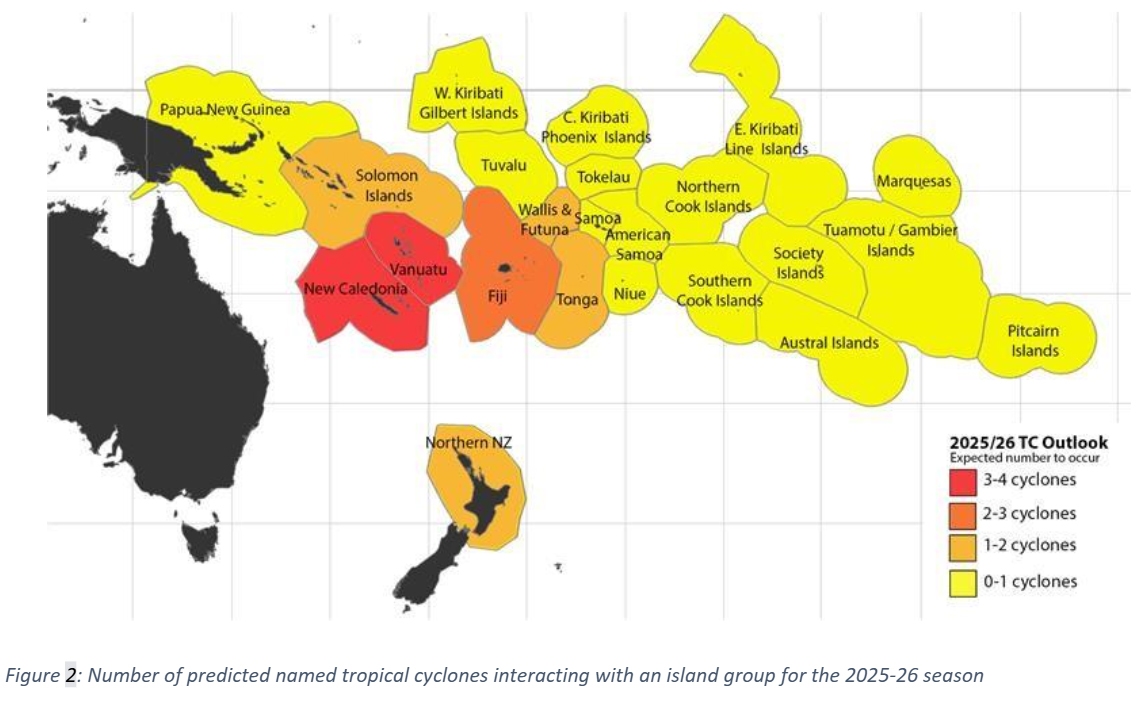
- Vanuatu and New Caledonia typically experience the greatest TC activity with an average of two or three TCs passing nearby each year.
- Normal or elevated activity: Vanuatu, New Caledonia and Northern New Zealand.
- Near normal activity: Fiji.
- Normal or reduced activity: Solomon Islands, Papua New Guinea, Tonga, Tuvalu, Tokelau, and Wallis & Futuna.
- Reduced activity: Samoa, American Samoa, Niue, Society Islands, Southern Cook Islands and Austral Islands.
- Activity unlikely: Marquesas, Kiribati, Northern Cook Islands, Tuamotu Archipelago, and Pitcairn Islands.
- Between 2-4 severe TCs reaching category 3 or higher may occur anywhere across the region, so all communities should remain prepared.
- Past seasons with similar conditions to the present, called “analogue years”, suggest multiple TCs could intensify to at least category 3 strength.
- Category 5 strength TCs, in which sustained winds are 200 km/h or greater, are associated with a majority of the analogue years. [Since quality observations began in the early 1970s, there has been a trend toward fewer but stronger TCs.]
- Despite the official season running from November through April, TCs sometimes occur out-of-season.
- It does not take a direct hit or severe TC to cause considerable damage or life-threatening weather. When dangerous weather is forecast, please heed the advice of your local meteorological service, civil defence, or disaster management office.
Tropical cyclone outlook summary for New Zealand
- On average, at least one ex-TC passes within 550 km of New Zealand each year. This season, the risk is considered normal or elevated, with expectations that risk of an interaction will increase in late summer and autumn.
- If an ex-TC tracks close to the country, there is a near-equal probability of it tracking to the east or west of the North Island based on historical observations.
- Three out of eight analogue years considered in this outlook had at least one ex-TC passing within 550 km of the country.
- Analogue years suggest that a decaying ex-TC entering the New Zealand region could affect maritime and coastal areas around the North Island, and an interaction with the South Island cannot be ruled out.
- Significant rainfall, extreme winds, hazardous marine conditions, and coastal damage are all possible leading up to and during ex-TC events.
- The effects of ex-TCs can also be spread over a large area, particularly if the decaying ex-TC interacts with mid-to-high latitude weather systems.
El Niño-Southern Oscillation outlook
- The El Niño Southern Oscillation (ENSO), comprised of La Niña, neutral, and El Niño phases, plays an important role in year-to-year regional TC development and spatial coverage and is a key factor in this outlook.
- As of early October 2025, sea surface temperatures across the eastern and central equatorial Pacific Ocean are below average and near La Niña thresholds.
- Atmospheric circulation patterns related to ENSO over French Polynesia and northern Australia indicate neutral ENSO conditions as of early October 2025.
- Oceanic and atmospheric forecasts for ENSO suggest weak-to-moderate La Niña conditions have an 85% chance of emerging by October-December 2025. La Niña conditions, should they develop, are likely to persist through early 2026, with deterioration of the event during the back half of the TC season in February-April 2026.
- The progress of ENSO and TC activity will continue to be tracked with an update to this guidance in January 2026.
For comment please contact:
Mr Chris Brandolino, Principal Scientist – Forecasting and Media, Earth Sciences NZ*
Dr Andrew Lorrey, Principal Scientist – Climate and Environmental Applications, Earth Sciences NZ*
In the Pacific Islands, please contact your local national meteorological service for information about how this guidance should be interpreted. In Australia and the associated offshore islands, please contact the Australian Bureau of Meteorology. In French Polynesia, Wallis & Futuna, and New Caledonia please contact Météo-France.
For the latest issue of the tropical cyclone outlook and a video presentation discussing expected regional tropical cyclone activity, head to https://niwa.co.nz/climate/southwest-pacific-tropical-cyclone-outlook.
*N.B. As of 1 July 2025, Crown Research Institutes NIWA and GNS Science were combined to form the Public Research Organisation Earth Sciences New Zealand.
Download
Southwest Pacific Tropical Cyclone Outlook - October 2025 [PDF 1.5MB]