
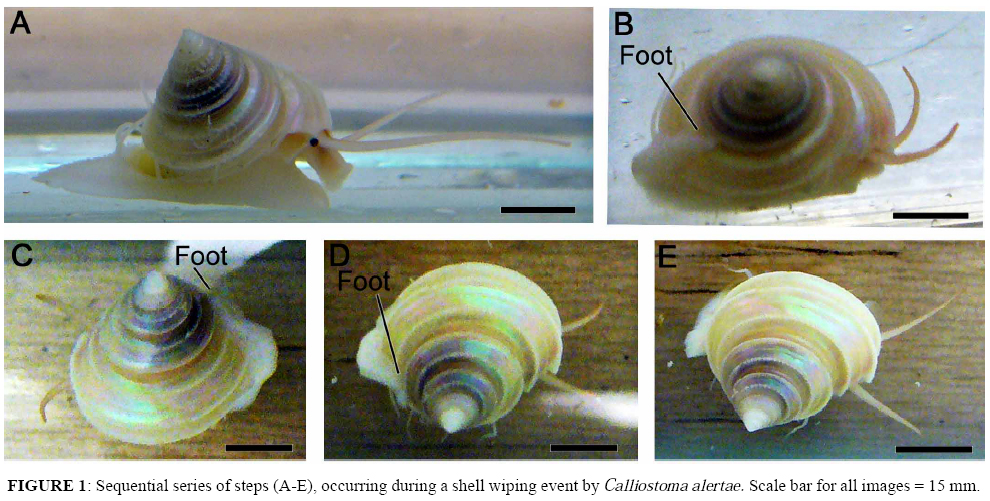
A paper by Holmes, Duncan & Schnabel (2010 in the journal Molluscan Research) reported some behavioural observations that may go some way to explaining why the calliostomid shells are often to beautifully shiny. Specimens of C. alertae were collected on the Challenger Plateau Ocean Survey 2020 voyage in 2007 (see also specimen image above) and kept alive in a seawater tank. A peculiar behaviour called ‘shell wiping’ was observed, at least once every 24 hours. The snail extends its foot and sweeps it up and along the outside of the shell, a process that took about an hour. The authors hypothesise that this behaviour functions to reduce shell fouling but may also provide extra food particles. The image shows a compilation of images representing the sequential steps of the shell-wiping process as published in the paper.