
Funded by the Ministry of Business, Innovation and Employment (MBIE)’s Endeavour fund, Earth Sciences NZ researchers are developing a physics-informed and artificial intelligence (AI)-driven method to vastly reduce the computer power needed to provide accurate climate change projections.
These projections will be based on downscaling multiple models (known as ensembles), which are critical for characterising uncertainty associated with climate-related risks.
The work supports Aotearoa’s transition to a low-emissions, climate-resilient economy. It helps New Zealanders better understand their climate-related risks across immediate, medium and long-term timescales. This improves decision-making for climate adaptation and support resilience to extreme weather events.
For instance, more actionable climate projections help:
- farmers plan for future irrigation needs
- horticulturalists to understand future heat stress and plan crops
- winemakers understand how temperatures might change and affect grape varieties
- councils to plan infrastructure and new developments based on future weather hazards.
Climate models require vast computing power
Our understanding of how global climate will respond to future increases in greenhouse gases depends on sophisticated climate models that require vast computing power to run. For New Zealand, we can use these climate models to tell us how weather patterns may change in a future with increased greenhouse gas emissions.
Even with massive supercomputers, the complexity of these global models means they can only be run at 50-150km resolutions – so places that are close together but with dramatically different weather and climate (think Mt Cook vs Twizel, for instance) have the same projections. The coarse resolution of these climate models is a barrier to societal decision making, as it cannot resolve of more localised changes across New Zealand’s terrain.
Regional Climate Models (RCMs) are computer models which further enhance the resolution of these global climate models and provide higher resolution climate projections that resolve New Zealand’s complex terrain. However, there remains an enormous computational cost of generating high-resolution climate projections.
About the project
The computational expense of current regional climate models (RCMs) directly limits the number of ensemble members that can be simulated at high-resolution. Without a 10-fold or more increase in RCM compute speed, downscaling climate projections of a large model ensemble at high spatial resolution is not likely feasible in the next decade. The Earth Sciences New Zealand-led team is developing the first physics-informed artificial intelligence (AI)-driven RCM emulator for climate projections, enabling large ensembles of very high-resolution (2-12km) projections for the entire country.
In 2025 we released the first version of a new downscaled dataset produced by AI called REMS-MR (Regional Emulation of Model Simulations – Mesoscale Resolution). This state-of-the-art dataset was developed by training generative AI models (in particular, Generative Adversarial Networks; GANs) on existing physics-based regional climate model output. This new dataset includes over 15,000 years of model simulations, downscaling over 20 global climate models for multiple emissions scenarios at 12km resolution over New Zealand. By producing a much larger ensemble of downscaled simulations, this dataset can be used to quantify different sources of uncertainty in the projections and used to quantify projected changes in extremely rare weather and climate events. The new dataset complements (and is trained from) the physics-based CMIP6 downscaled simulations hosted by MfE and developed by NIWA in 2024 (more information here: https://niwa.co.nz/climate-and-weather/updated-national-climate-projections-new-zealand). More information about this dataset and the methodology can be found in Rampal et al., (2026).
Ongoing work by the team is testing and improving the generative AI models that underpin the REMS-MR datasets, by comparing results from different state-of-the-art approaches (flow matching, diffusion models and GANs). Plans are also underway to increase the temporal resolution (daily to hourly) and spatial resolution (12 km to 2 km). Additional work will include testing and improving the representation of physical processes in the AI model (e.g. land-atmosphere feedbacks) and the physical consistency across a larger set of model output variables.
The motivation for these developments, particularly the move to 2 km resolution, is to develop generative AI RCM emulators that can reliably simulate unprecedented record-shattering weather and climate events (e.g. the 2023 Cyclone Gabrielle and Auckland Anniversary events). Once complete, these newly developed AI-driven RCM emulators will be used to produce tens of thousands of years of climate simulations at 2 km resolution, to study these events and how they might change in a warmer world. Such events are rare and cannot be reliably anticipated from short observational records — for example, events such as Cyclone Gabrielle and the Auckland Anniversary floods occur only a handful of times within our observational record. Long-duration climate simulations can therefore help us study and sample these events more reliably, as illustrated in Figure 1.
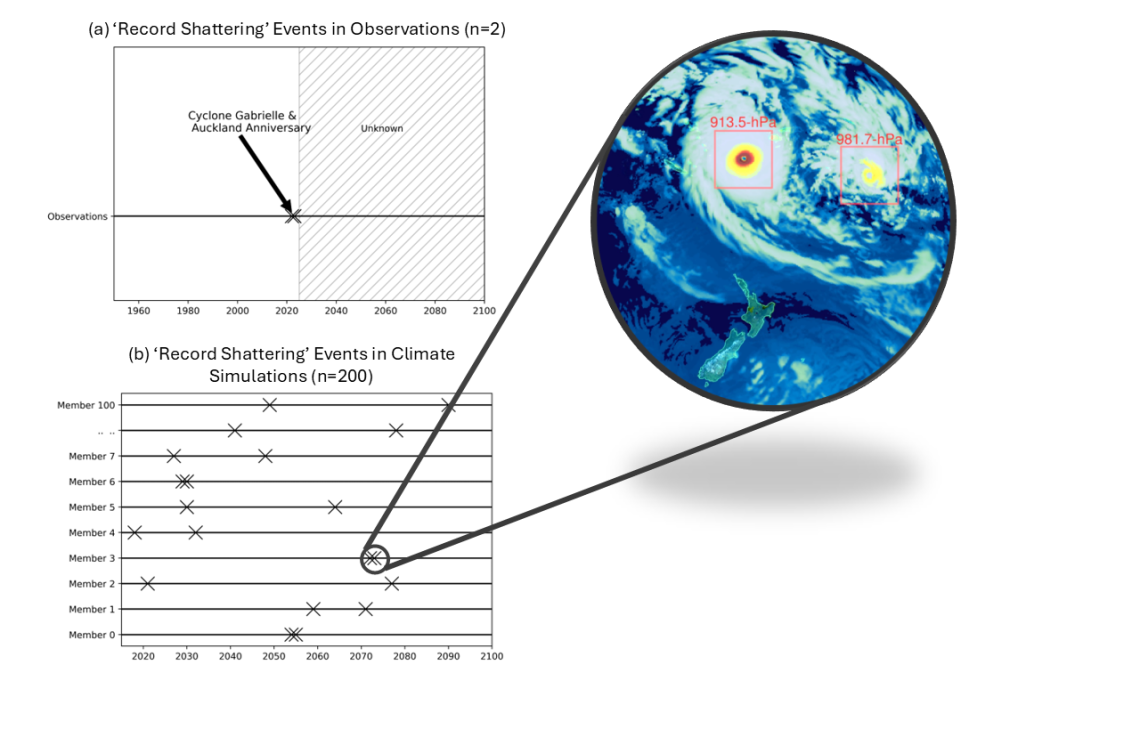
Figure 1. Record-shattering events in observations versus climate simulations. A record-shattering event is an extreme that breaks prior records by a large margin (e.g. Cyclone Gabrielle and the Auckland Anniversary events of 2023). (a) Observations give us only one version of reality, so only a few of such events have occurred historically; future occurrences remain unknown (hatched region). (b) Climate simulations give us many possible versions of reality (ensemble members), each following a different but equally plausible weather sequence. This means we can sample many more plausible record-shattering events (✕) in climate simulations. The magnified panel shows an example compound extreme weather event that occurred in a climate simulation— two extreme low-pressure systems occurring simultaneously (913.5 hPa and 981.7 hPa), drawn from one ensemble member.
We will use RiskScape to estimate the direct socioeconomic exposure (e.g., affected population, buildings and infrastructure network components) from individual and compound hazards under climate change. We will further explore the use of network and interdependency models to study the wide-spread cascading effects from infrastructure network failures for the events causing greatest socioeconomic exposure.
The team will engage with key stakeholders throughout the project, including iwi/hapū, regional councils, central government, and industry leaders to ensure research outputs will enable higher-value products and services. The provision of improved climate projections will support a variety of industries which span finance, insurance, weather forecasting, and primary industries.
Research papers
Peer-reviewed:
Gibson, P.B. and Rampal, N., (2026): Regional climate downscaling: Dynamical and machine learning approaches, in Climate Modelling, Encyclopedia of Climate System Science, Elsevier, in press.
Rampal, N., Gibson, P. B., Sherwood, S. C., Queen, L. E., Lewis, H., & Abramowitz, G. (2026a). Downscaling with AI reveals the large role of internal variability in fine-scale projections of climate extremes. Climate Dynamics (Accepted; arXiv preprint arXiv:2507.06527).
Rampal, N., Gibson, P. B., Sherwood, S., Abramowitz, G., & Hobeichi, S. (2025). A reliable generative adversarial network approach for climate downscaling and weather generation. Journal of Advances in Modeling Earth Systems, 17(1), e2024MS004668.
Evans, J. P., Belmadani, A., Menkes, C., Stephenson, T., Thatcher, M., Gibson, P. B., & Peltier, A. (2024). Higher-resolution projections needed for small island climates. nature climate change, 14(7), 668-670.
Rampal, N., Gibson, P. B., Sherwood, S., & Abramowitz, G. (2024). On the extrapolation of generative adversarial networks for downscaling precipitation extremes in warmer climates. Geophysical Research Letters, 51(23), e2024GL112492.
Rampal, N., Hobeichi, S., Gibson, P. B., Baño-Medina, J., Abramowitz, G., Beucler, T., ... & Gutiérrez, J. M. (2024). Enhancing regional climate downscaling through advances in machine learning. Artificial Intelligence for the Earth Systems, 3(2), 230066.
Gibson, P. B., Rampal, N., Dean, S. M., & Morgenstern, O. (2024). Storylines for future projections of precipitation over New Zealand in CMIP6 models. Journal of Geophysical Research: Atmospheres, 129(5), e2023JD039664.
Bailie, T., Koh, Y. S., Rampal, N., & Gibson, P. B. (2024). Quantile-regression-ensemble: A deep learning algorithm for downscaling extreme precipitation. In Proceedings of the aaai conference on artificial intelligence (Vol. 38, No. 20, pp. 21914-21922).
Under review:
Rampal, N., González-Abad, J., Addison, H., Baño-Medina, J., Bettolli, M. L., Blasone, V., Booth, B., Coppola, E., Di Gioia, S., Oldham-Dorrington, J., Doury, A., Engelbrecht, F., Fuentes-Franco, R., Gibson, P. B., Glawion, L., Hardy, C., Ivanov, M., Lee, H. K., Legasa, M. N., ... Gutiérrez, J. M. (2026). CORDEX-ML-Bench: A benchmark for data-driven regional climate downscaling – Experiment design and overview (Under review at the Journal of Advances in Modeling Earth Systems; JAMES). arXiv. https://arxiv.org/abs/2606.29172
Rampal, N., Ward-Leikis, B., Koh, Y. S., Gibson, P. B., Liu, H. Y., Kitsios, V., ... & Sherwood, S. C. (2026). An intercomparison of generative machine learning methods for downscaling precipitation at fine spatial scales (Under review at JGR; ML and Computation). arXiv preprint arXiv:2512.13987.
Lewis, H., Rampal, N., Gibson, P. B., Harrington, L. J., Holgate, C. M., Ukkola, A., & Maher, N. M. (2025). Generative AI-downscaling of large ensembles project unprecedented future droughts (Under review at Weather and Climate Extremes; WACE). arXiv preprint arXiv:2509.21844.
Gibson, P.B., Queen, L.E., Rampal, N., Polz, J., and Evans, J., (2026): Longer training data improves precipitation extremes in regional climate model emulators, Artificial Intelligence for the Earth Systems, in review.

